How to Hedge AI Bubble 2026: 5 Proven Defensive Plays
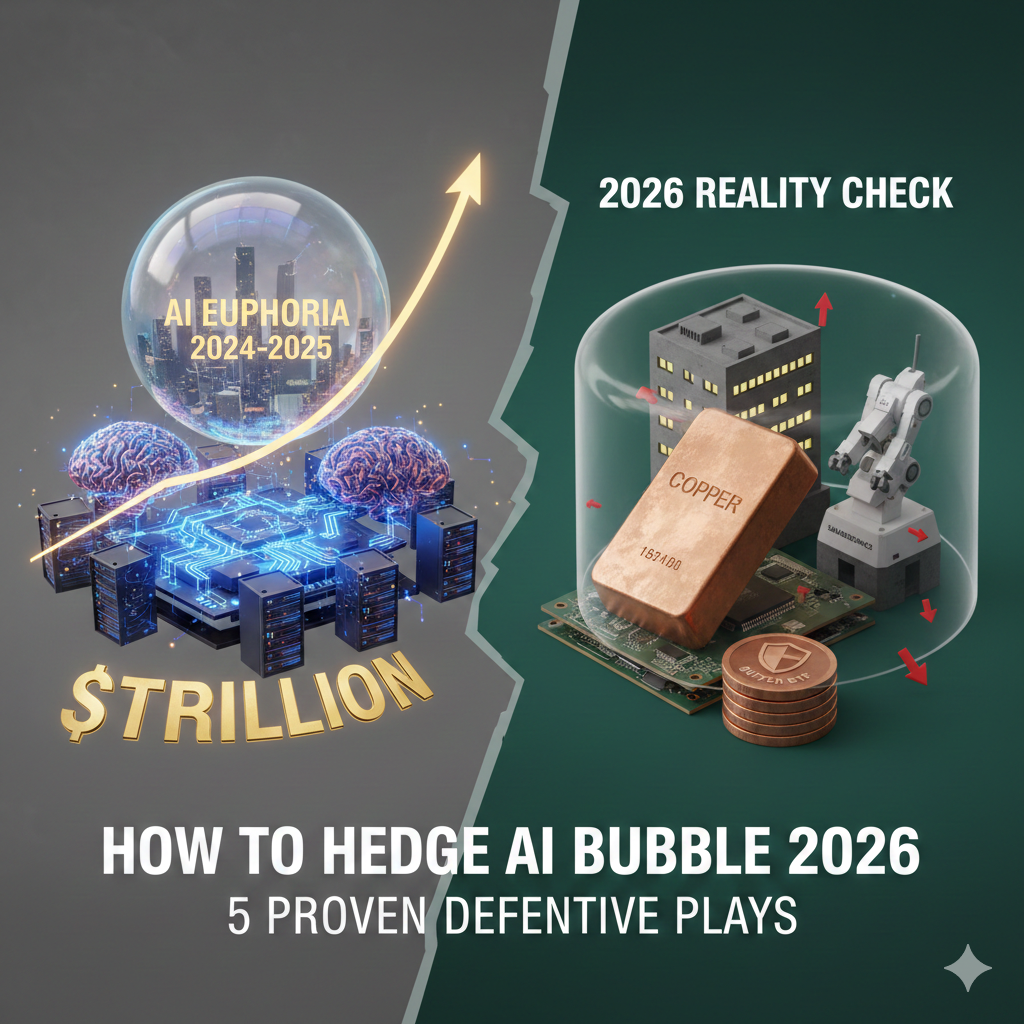
As we navigate the opening months of 2026, the global financial markets are grappling with a profound transition. The era of speculative AI euphoria—characterized by the “giddy, trillion-dollar promise” of 2024 and 2025—is being replaced by a stark “reality check.” For the savvy retail investor, the primary question is no longer how to catch the next rocket ship, but rather how to hedge AI bubble 2026 to protect against a potential “Turning Point” in the cycle.
The current landscape is defined by a widening “execution gap.” While enterprise spending on AI infrastructure reached a staggering $405 billion in 2025, early 2026 data shows that only 15% to 19% of organizations have successfully moved beyond pilot projects into full, profitable workflow integration. This has created a “priced for perfection” environment where mega-cap technology names now account for roughly 61% of the market capitalization of major growth indices. In this guide, we break down the most effective macro-hedging strategies to insulate your portfolio from the volatility of the 2026 AI bubble.
- The 2026 AI Bubble Reality Check: Defining the Execution Gap
- Pillar 1: The Infrastructure Pivot – Copper and the Power Scarcity
- Pillar 2: Data Center REITs – Stable Income in a Volatile World
- Pillar 3: The Buffer Zone – Using Defined Outcome ETFs
- Pillar 4: Sanaenomics – Japan as a Non-Correlated Safety Valve
- Pillar 5: Tactical Inverse Strategies and SEC Regulatory Limits
- Strategic Risk: Active vs. Passive AI bubble Hedging in 2026
- Expert Conclusion and Call to Action
The 2026 AI Bubble Reality Check: Defining the Execution Gap
To understand how to hedge AI bubble 2026, we must first identify the fundamental risk: the “Execution Gap.” In 2024, the narrative was built on potential. By 2026, the market has moved into a “Turning Point” phase where speculation fades and reality sets in.
Recent research from Forrester indicates a significant disparity: only about 15% of AI decision-makers reported a positive impact on profitability in the last 12 months. Furthermore, while 81% of executives originally anticipated a measurable ROI within one year, many projects have remained stuck in the “exploration” phase rather than scaling to “exploitation.” This has led to a predicted market correction, with some enterprises expected to defer up to 25% of their planned 2026 AI spending into 2027.
For the investor, this means that the “OpenAI Profitability Paradox” is now a board-level concern: can even the most successful AI firms justify their multi-billion dollar valuations without immediate, sustainable cash flow? The 2026 market is on a “diffusion ultimatum”—for the current valuations to hold, the benefits of AI must spread beyond the chipmakers and cloud providers into healthcare, manufacturing, and traditional services. If this “diffusion” fails to manifest, the concentrated gains seen in 2025 (where AI accounted for 80% of US market gains) could face a severe mean reversion.
Pillar 1: The Infrastructure Pivot – Copper and the Power Scarcity
One of the most robust ways to learn how to hedge AI bubble 2026 is to pivot from software models to the “inelastic” physical assets required to run them. Every line of AI code requires electricity, and every watt of that electricity must flow through copper wiring.
Copper: The Fundamental “AI Metal”
Copper is no longer just a bellwether for the industrial economy; it has become the fundamental constraint of the AI revolution. By early 2026, LME copper prices have surged past $12,000 per metric ton, a 42% year-to-date increase.
- Inelastic Demand: Data centers are projected to drive global copper demand growth of 24% by 2035.
- The Supply Crunch: It takes an average of 17 years to bring a new copper mine online. This structural deficit means that even if the AI software bubble “pops,” the demand for copper to maintain existing and under-construction infrastructure remains high.
- Retail Investment Options: Diversified copper ETFs like the Global X Copper Miners ETF (COPX), which is up over 95% year-to-date, or individual majors like Freeport-McMoRan (FCX) and BHP Group (BHP), offer a direct hedge against tech-sector volatility.
Utilities and the “Power Expectation Gap”
The AI race runs on electricity. In the US, total IT load capacity is projected to double from 80 GW in 2025 to 150 GW by 2028. However, a critical “power expectation gap” has emerged: hyperscalers expect power to be available 1.5 to 2 years earlier than utilities can realistically deliver it.
- Firm Capacity: In 2026, the challenge for utilities is delivering “firm” or uninterrupted capacity to stressed grids. This has led to a “nuclear renaissance,” with the US administration aiming to quadruple nuclear capacity to 400 GW by 2050 to support AI data centers.
- The Texas Shift: Because of permitting complexities in legacy markets like California, the AI infrastructure buildout is shifting toward power-advantaged states like Texas, which is poised to become the nation’s leading data center market by 2028.
Pillar 2: Data Center REITs – Stable Income in a Volatile World
While high-performance chips like Nvidia were the top play in 2024, the “second act” of the AI revolution belongs to the landlords. Real Estate Investment Trusts (REITs) that specialize in data centers offer a unique way to hedge the AI bubble by moving from speculative growth to high-yield, predictable income.
Why Data Center REITs?
- Stable Income Streams: These companies sign long-term leases with high-credit tenants like Amazon, Google, and Microsoft, providing reliable cash flow even during market turbulence.
- Mandatory Distributions: As REITs, these firms are required by law to distribute at least 90% of their taxable income to shareholders as dividends.
- Scale and Interconnection: Leaders like Equinix (EQIX) and Digital Realty (DLR) operate global platforms that create “network effects.” For example, Equinix is the top choice for investors who value its dominant “interconnection” ecosystem, while Digital Realty focuses on the massive “hyperscale” demand from AI training projects.
Retail investors should monitor FFO (Funds From Operations) instead of traditional earnings when evaluating these stocks, as FFO is a more accurate measure of a REIT’s actual cash flow and ability to pay dividends.
Pillar 3: The Buffer Zone – Using Defined Outcome ETFs
For retail investors who want to stay invested in the S&P 500 but fear a 10% to 20% crash, S&P 500 Buffer ETFs (also known as Defined Outcome ETFs) have become the go-to “market insurance” in 2026.
How Buffer ETFs Protect Your 2026 Portfolio
These funds use options strategies to provide a predetermined level of downside protection (the “buffer”) in exchange for a “cap” on the upside potential over a one-year target period.
- The Protection Mechanics: If you buy a “10% Buffer” ETF and the S&P 500 drops 10%, the fund is designed to stay flat (0% loss).
- Targeted Protection: iShares and Aptus offer several tiers of protection for 2026:
- TEND (iShares Large Cap 10% Target Buffer Dec): Started 2026 with a 16.15% upside cap and a 10% downside buffer.
- JANB (Aptus January Buffer ETF): Offers a 15% downside buffer with a starting cap of 14.05%.
- MMAX (iShares Large Cap Max Buffer Mar): Designed for extreme safety, offering 100% (full) downside protection, though the upside is capped much lower (around 7.6%).
The Strategy of Laddering
Financial professionals often suggest a “laddered” approach—holding multiple buffer ETFs with different quarterly start dates (e.g., JANB, APRB, JULB, OCTB). This ensures that your protection levels are periodically “reset” to current market prices, so your buffer isn’t depleted by a single long rally.
Pillar 4: Sanaenomics – Japan as a Non-Correlated Safety Valve
In early 2026, Japan has emerged as a premier non-correlated hedge to US technology volatility. This trend is driven by “Sanaenomics,” the economic agenda of Prime Minister Sanae Takaichi.
Physical AI vs. Digital AI
While the US market is heavily weighted toward “Digital AI” (SaaS and LLMs), Japan is the global leader in “Physical AI”—the industrial robotics, factory automation, and hardware needed for global reindustrialization.
- The Takaichi Trade: Takaichi’s victory has strengthened expectations of increased defense spending (above 2% of GDP) and targeted investments in semiconductors, quantum computing, and economic security.
- Corporate Governance Catalyst: In 2026, the Tokyo Stock Exchange is taking its final restructuring step by initiating delisting procedures for companies that fail to improve shareholder returns or capital allocation. This is forcing Japanese firms to unlock their massive cash piles (totaling over ¥115 trillion) through buybacks and dividends.
- Hedged Exposure: Retail investors can access this trend using the WisdomTree Japan Hedged Equity Fund (DXJ), which is up 25% year-to-date and neutralizes the risk of Yen currency fluctuations.
| Sanaenomics Stock Watchlist (2026) | Ticker/Player | Hedge Rationale |
|---|---|---|
| Industrial Robotics | Fanuc, Keyence | Leaders in “Physical AI” and automation |
| Defense Spending | Kawasaki Heavy, IHI Corp | Direct beneficiaries of increased defense budget |
| Semiconductor Ecosystem | Advantest, Disco | Support for “Rapidus” next-gen chip project |
| Reflation Winners | MUFG, Mizuho | Beneficiaries of Bank of Japan interest rate hikes |
Pillar 5: Tactical Inverse Strategies and SEC Regulatory Limits
For sophisticated retail investors looking for short-term downside protection, inverse AI ETFs are a powerful tool. However, the regulatory environment in 2026 has changed significantly.
The SEC “Line in the Sand”
In late 2025 and early 2026, the US Securities and Exchange Commission (SEC) issued a series of warning letters to fund sponsors like Direxion and ProShares. The regulator has effectively blocked the registration of ETFs offering more than 2x (200%) leveraged exposure to single stocks.
- The Rule 18f-4 Test: Under these rules, a leveraged ETF must run a “Value-at-Risk” test using the actual asset it tracks as its benchmark. High-leverage products (3x or 5x) on volatile stocks like Nvidia or Tesla often fail this test.
- The Tactical Menu: Despite these limits, retail investors can still use:
- NVDS (Direxion Daily NVDA Bear 1X Shares): A simple 1-to-1 inverse play on Nvidia.
- AIBD (Direxion Daily AI and Big Data Bear 2X Shares): Provides 2x inverse exposure to the Solactive US AI & Big Data Index.
- SOXS (Daily Semiconductor Bear 3X Shares): Still exists as a 3x inverse for the broader sector index, though it is strictly for intraday or very short-term use.
Critical Warning: Leveraged and inverse ETFs are not “buy and hold” investments. Because of daily rebalancing and the effects of compounding, their performance over a month or a year will differ significantly from the inverse of the index. They should be used only for tactical, short-term protection during periods of high volatility.
Strategic Risk: Active vs. Passive AI bubble Hedging in 2026
The final layer of how to hedge AI bubble 2026 involves a fundamental shift in how you build your portfolio: the move from passive index tracking to “Alpha Enhanced” active strategies.
The Passive Trap
The dominance of passive funds in 2024-2025 created a cycle where funds were “forced to keep buying” mega-caps to match the index, further inflating their prices. By 2026, the top 10 companies in the Russell 1000 Growth account for over 60% of the index. If the AI bubble pops, passive investors will be the last ones out, taking the full brunt of the correction.
The “Alpha Enhanced” Solution
Strategists at Goldman Sachs and J.P. Morgan now advocate for Alpha Enhanced strategies. This approach offers a middle ground:
- Cost Efficiency: They maintain the low fees of passive funds.
- Active Risk Management: Managers take small, diversified active bets across market caps and geographies to avoid “unintended risk exposures” in over-concentrated tech sectors.
- Dispersion Harvesting: In a “K-shaped” economy (where some AI firms win and many lose), active managers can harvest “alpha” by picking the specific winners rather than owning the whole bloated index.
Expert Conclusion and Call to Action
Strategic hedging of AI bubble in 2026 is about moving from “Supply-Side Hype” to “Demand-Side Reality.” By rebalancing 10-15% of a tech-heavy portfolio into Copper, Data Center REITs, and Buffer ETFs, retail investors can stay engaged in the market’s growth while maintaining a structural safety net. Review your concentration in the “Mag-7” today—if those ten stocks represent more than 30% of your total net worth, it may be time to implement the defensive pillars of the 2026 Safety Playbook.
Stay Informed with Macro Data: To understand the global context of this trade, we recommend reviewing the J.P. Morgan 2026 Market Outlook. Their data confirms that multidimensional polarization—specifically between AI-driven sectors and regional shifts like Sanaenomics—will define the winners of this year.
Disclaimer: This guide is for educational purposes and does not constitute financial advice. Always consult a certified financial professional before making significant investment decisions.