2026 AI Capex ROI Discipline: Navigating the Shift from Infrastructure Hype to Earnings Reality
2026 AI Capex ROI discipline represents the definitive strategic shift from speculative AI infrastructure accumulation to a rigorous, outcome-based capital allocation framework. In 2026, the focus has moved from acquiring raw compute power to demonstrating measurable P&L impact. As aggregate hyperscaler capital expenditures (Capex) are projected to exceed $740 billion, this discipline dictates that every dollar of investment must be tethered to specific value realization metrics. Organizations are now prioritizing “AI 2.0” deployments—characterized by agentic workflows and workload repatriation—to ensure that the massive investments of the 2024–2025 “GPU land grab” translate into sustainable corporate earnings and shareholder value.
- The Infrastructure Inflection: Defining 2026 AI Capex ROI Discipline
- The $740 Billion War Chest: Hyperscaler Spending Analysis
- Game Theory in Silicon Valley: The Nash Equilibrium of Compute
- Financing the AI Supercycle: The Shift to Debt and Leverage
- The Rise of the Value Realization Office (VRO)
- The Great Repatriation: Infrastructure Optimization and the 60-70% Rule
- AI 2.0 and Agentic Productivity: The New ROI Multipliers
- The S&P 500 Earnings Gap: Reconciling Capex with P&L Reality
- Risk Factors: Power Constraints, Circular Financing, and Regulation
- Conclusion: The Discipline or Die Era
The Infrastructure Inflection: Defining 2026 AI Capex ROI Discipline
The global macroeconomic landscape in 2026 is defined by a singular tension: the divergence between unprecedented technological investment and the intensifying demand for fiscal responsibility. The previous era, spanning 2023 to 2025, was characterized by a “land grab” mentality, where the primary objective was the procurement of Nvidia H100s, H200s, and Blackwell architectures at any cost. However, the current regime has evolved into the era of 2026 AI Capex ROI discipline. This shift is not merely a change in accounting preference but a structural evolution in the tech-finance complex. The “move fast and break things” ethos has been replaced by “scale with precision and prove the value.”
This discipline is necessitated by the sheer scale of the capital being deployed. When capital expenditure across the largest technology firms reaches levels approaching 1.4% of national GDP—a level not seen since the peak of the 1990s internet bubble—the margin for error diminishes to near zero. Investors are no longer satisfied with hearing about “potential use cases” or “pilot programs.” They are looking for the “Value Realization” check: the moment where the massive Capex outlays of the last 24 months finally cross the threshold into positive Free Cash Flow (FCF).
The conceptual framework of 2026 AI Capex ROI discipline rests on three pillars. First is the shift from “AI 1.0” (infrastructure and model training) to “AI 2.0” (inference-led productivity and agentic workflows). Second is the institutionalization of value tracking through the Value Realization Office (VRO), which replaces the traditional Project Management Office as the arbiter of success. Third is the optimization of the infrastructure stack itself, moving away from “cloud-only” dogmas toward a sophisticated hybrid model where the most expensive workloads are repatriated to private or colocated environments to save 50% or more on compute costs.
The $740 Billion War Chest: Hyperscaler Spending Analysis
The financial magnitude of the current AI build-out is historically unprecedented. For the “Big Five”—Amazon, Alphabet, Meta, Microsoft, and Oracle—combined capital guidance for 2026 is now widely forecast to exceed $660 billion, with some aggressive estimates placing the total, including emerging players like CoreWeave, as high as $740 billion. This represents a nearly 70% year-over-year increase from 2025 levels, a surge that has caught many institutional analysts by surprise.
Amazon continues to lead the pack, projecting a total Capex of $200 billion for 2026. While a portion of this is dedicated to its logistics and retail empire, the vast majority is funneled into AWS data centers and the underlying power infrastructure required to support them. Microsoft follows closely, tracking toward $120 billion or more. Interestingly, Microsoft has disclosed an $80 billion backlog of Azure orders that it currently cannot fulfill, not due to a lack of demand, but because of physical constraints in the global power grid. This “backlog of growth” provides a crucial buffer for Microsoft’s ROI narrative, suggesting that its spending is not speculative but is chasing a massive, pre-existing demand curve.
Alphabet and Meta have also significantly revised their guidance upward. Alphabet is projected to spend between $175 billion and $185 billion, while Meta, despite not being a traditional cloud provider, is spending $115 billion to $135 billion on its own Llama-driven ecosystem and massive data center clusters in Louisiana and Ohio. Oracle, which has positioned itself as the “GPU-as-a-Service” leader, has targeted $50 billion in Capex, an enormous sum relative to its scale, which it plans to fund through a mix of debt and equity-like instruments.
2025 vs 2026 Capex Projections and Strategic Focus
| Company | 2025 Capex (USD Bn) | 2026 Projected Guidance (USD Bn) | Primary ROI Driver / Strategic Focus |
| Amazon | $132 | $200 | AWS Infrastructure & AI-Driven Logistics |
| Alphabet | $90-100 | $175-185 | TPU Development & Consumer Search AI |
| Microsoft | $105-110 | $120+ | Azure Cloud & OpenAI Integration |
| Meta | $72 | $115-135 | Llama Model Training & Ad-Recommender Systems |
| Oracle | $21 | $50 | GPU-as-a-Service & Sovereign Cloud Nodes |
| Total (Big 5) | ~$425 | ~$660-690 | The $700B Infrastructure Sprint |
This massive capital intensity is driving a divergence in corporate health. Analysts note that while these companies are “hyperspending,” they are doing so because the alternative—falling behind in the AI arms race—is seen as an existential threat. This leads us to the game-theoretic underpinnings of the 2026 market.
Game Theory in Silicon Valley: The Nash Equilibrium of Compute
To understand why 2026 AI Capex ROI discipline is so difficult to maintain, one must look at the Nash Equilibrium currently dominating Silicon Valley. In game theory, a Nash Equilibrium occurs when each player chooses the best strategy for themselves, given the strategies of all other players, and no one has an incentive to deviate. For Microsoft, Google, and Amazon, the strategy is binary: either you build the infrastructure for the next generation of computing, or you risk permanent strategic obsolescence.
This dynamic creates a classic Prisoner’s Dilemma. If all hyperscalers were to collectively reduce their Capex, their margins would improve, and the “AI bubble” fears would subside. However, if any single firm pauses its investment, it loses its place in the “winner-takes-all” compute hierarchy. Just as IBM missed the cloud revolution and became a legacy player, the current tech titans fear that a one-year pause in GPU procurement could lead to a decade-long loss of market share.
The “Option Value” of staying in the race is currently being priced higher than the “Return Value” of the capital itself. As analysts from T. Rowe Price have observed, this cycle is better understood as a “competitive necessity” rather than a discretionary boom. The persistence of scaling laws—where more compute reliably leads to more capable models—means that the strategic rationale for spending remains intact even when near-term project-level returns are debated in the press.
However, the “discipline” in 2026 AI Capex ROI discipline comes from how this spending is being managed internally. Rather than just buying GPUs, firms are focusing on “disciplined capacity allocation.” This involves shifting compute resources to the highest-margin workloads in real-time and utilizing internal “Value Realization” frameworks to ensure that the infrastructure is actually being utilized by customers. The goal is to avoid the “Global Crossing” fate of the early 2000s, where massive fiber-optic networks were built but remained “dark” because demand didn’t materialize fast enough.
Financing the AI Supercycle: The Shift to Debt and Leverage
One of the most profound shifts in 2026 is how this $700 billion-plus bill is being paid. For the first time in the modern tech era, internal free cash flows (FCF) are no longer sufficient to cover the industry’s capital ambitions. Except for Microsoft, most major hyperscalers are seeing their operating cash flows almost entirely consumed by Capex, potentially leading to negative FCF in 2026 or 2027.
Consequently, the tech sector has transformed from a cash-hoarding industry into a major borrower in the global debt markets. The “Big Five” have tapped capital markets for more than $137.5 billion since late 2024, and this trend has accelerated into 2026.
The Historic Bond Issuance Wave of February 2026
The week leading up to February 11, 2026, will be remembered as a watershed moment for corporate finance.
- Oracle: Despite its stock price facing pressure due to concerns over default risk and negative cash flow, Oracle successfully issued a record-breaking $25 billion bond. The issuance was five times oversubscribed, attracting $129 billion in orders, proving that debt investors are still bullish on the AI narrative even as equity investors grow wary.
- Alphabet (Google): One week later, Google followed suit with its largest issuance ever: a $20 billion bond. Most notably, Google began floating the idea of a 100-year “century bond,” a financial instrument typically reserved for sovereign nations or centuries-old universities, signaling its belief that the AI supercycle is a generational event.
This shift has significant implications for the broader economy. AI-related debt now accounts for approximately 18% of the aggregate investment-grade (IG) corporate bond index. As the tech sector becomes a larger portion of the bond market, any “ROI disappointment” in AI won’t just hit tech stocks—it could trigger a broad-based repricing of the entire corporate credit landscape. The “margin for error” is now not just a corporate concern but a systemic risk.
The Rise of the Value Realization Office (VRO)
As the pressure to demonstrate ROI reaches the boardroom, the organizational response has been the creation of the Value Realization Office (VRO). In 2026, the VRO has replaced the traditional Project Management Office (PMO) as the “air-traffic controller” for enterprise transformation. While a PMO tracks whether a project is “on time and on budget,” a VRO tracks whether the project actually delivered its promised business value: cost savings, revenue uplift, or productivity gains.
The VRO is essential because “value erosion” rarely shows up as a sudden project failure. Instead, it manifests as stalled adoption, governance bottlenecks, or process friction that quietly drains the expected returns on a $100 million AI investment. The VRO addresses this by using AI-powered platforms to continuously measure and predict outcomes across the enterprise.
Value Realization Office (VRO) Framework vs. Traditional PMO
| Feature | Project Management Office (PMO) | Value Realization Office (VRO) |
| Philosophy | Activity-based (“Did we finish?”) | Outcome-based (“Did we profit?”) |
| Primary Metric | Milestones, Schedules, Task Completion | ROI, TCO Reduction, P&L Impact |
| AI Integration | Manual reporting and status updates | AI-powered predictive outcome tracking |
| Governance | Governance for compliance | Governance for value capture and accountability |
| Project Lifespan | Ends at “Go-Live” | Extends through the entire value lifecycle |
| Outcome | Tactical completion | Strategic “North Star” alignment via OKRs |
Professional services firms like TCS, Wipro, and Kyndryl are now helping CXOs “institutionalize benefit tracking”. For example, early adopters of VRO models have seen a 40% reduction in Total Cost of Ownership (TCO) and a 25% increase in time-to-market for new AI-enabled services. The VRO also serves as a “value controller,” flagging projects that are not meeting their KPIs and proactively “shutting down zombie projects” that drain capital without delivering results. This is the very definition of 2026 AI Capex ROI discipline at the enterprise level.
The Great Repatriation: Infrastructure Optimization and the 60-70% Rule
During the initial AI boom of 2024, the “cloud-first” mantra was absolute. However, the high costs of continuous inference and the “hidden” fees of the public cloud—such as egress charges and API hits—have led to a “Great Repatriation” in 2026. A staggering 86% of CIOs now plan to move at least some workloads back on-premise, a record high.
The guiding principle for this shift is the “60-70% Rule.” Deloitte research suggests that when public cloud costs reach 60% to 70% of the cost of acquiring and operating equivalent on-premises hardware, the economic rationale for the cloud breaks down for that specific workload. This is particularly true for steady-state AI workloads, such as a model running constant inference for fraud detection or a logistics recommender system that operates 24/7/365.
Case Studies in Infrastructure ROI Optimization
- GEICO: After spending a decade moving 600+ apps to the cloud, GEICO faced costs 2.5x higher than projected. In 2026, they are repatriating workloads to a private cloud powered by OpenStack and Kubernetes, cutting costs by 50% per compute core.
- 37signals (Basecamp & Hey): By exiting the cloud for its predictable workloads, the company is saving an estimated $2 million annually and projects over $10 million in savings over five years.
- Dropbox: Having famously moved 90% of its data off AWS years ago, Dropbox serves as the blueprint for 2026 repatriation, having saved $74.6 million in just two years after its initial $53 million infrastructure investment.
Repatriation in 2026 isn’t a rejection of the cloud, but a “strategic rebalancing”. Organizations are keeping their “burst” capacity and customer-facing apps in the cloud for global reach, while moving their heavy-duty “AI inference pipelines” to private data centers to lock in fixed costs and avoid the volatility of consumption-based billing.
AI 2.0 and Agentic Productivity: The New ROI Multipliers
The transition to 2026 AI Capex ROI discipline is also fueled by a technological shift from “Generative AI” (chatbots) to “Agentic AI” (autonomous agents). AI 1.0 was a capital spending story focused on building infrastructure and training models. AI 2.0 is where the financial benefits start accruing to companies through autonomous decision-making and process automation.
Agentic AI agents don’t just “chat”; they “act.” They can autonomously manage end-to-end operations, from incident resolution in IT to autonomous configuration generation in manufacturing. This shift is critical for ROI because it moves AI from a “cost center” to a “productivity engine.”
High-ROI AI 2.0 Use Cases in 2026
| Use Case | AI 2.0 Agentic Workflow | Projected Financial Impact |
| Autonomous Incident Resolution | Agents create, triage, and resolve IT tickets without human intervention. | 40-60% reduction in emergency operational costs. |
| Predictive Planning & Budgeting | Agents use advanced analytics to forecast financial outcomes and adjust budgets in real-time. | 30-45% improvement in forecast accuracy. |
| Supply Chain Orchestration | Task agents synchronize multiple workflows to manage disruptions and optimize inventory. | 8-15% working-capital release. |
| Embedded Finance | AI-driven autonomous lending and fraud detection platforms for banks. | $23 million+ in new pipeline revenue for early adopters. |
| Regulatory Reporting | Autonomous agents handle anomaly detection and financial consolidation for compliance. | Significant reduction in audit-ready evidence generation time. |
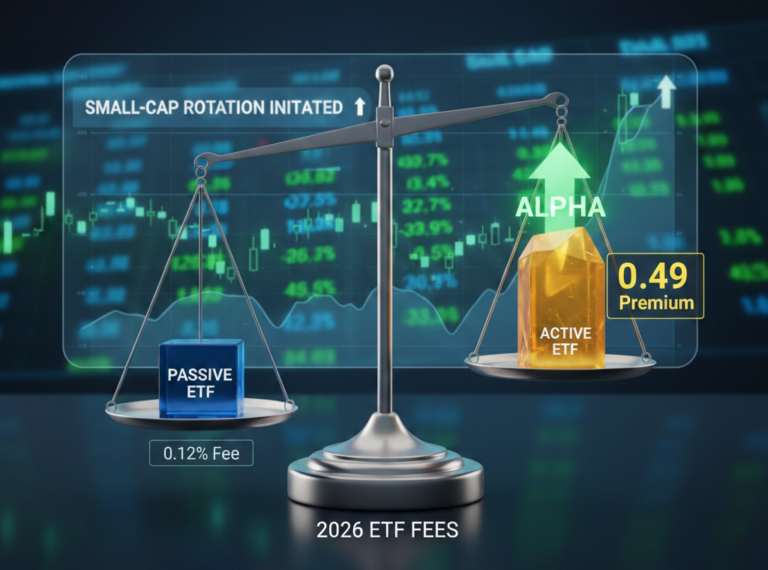
By late 2025, 54% of organizations reported positive ROI from their AI investments, a massive leap from the previous year. This success is driven by the move toward these “Agentic Task Orchestration” pipelines, which allow companies to scale their operations without a linear increase in headcount. As organizations discuss their tech-heavy portfolios, the question of cost vs. alpha becomes paramount. For instance, when evaluating investment strategies, one might ask:
The S&P 500 Earnings Gap: Reconciling Capex with P&L Reality
While individual enterprise use cases show promise, the macro-level challenge of 2026 is the “Earnings Gap.” To justify the $500–$600 billion in annual Capex being spent by the tech giants, these companies would need to achieve an annual profit run-rate of more than $1 trillion. However, the current consensus for 2026 profits is only $450 billion—a $550 billion shortfall that the market must eventually reconcile.
RBC Wealth Management analysts have noted that the 2026 S&P 500 profit forecast of 12.8% year-over-year growth (based on $310 earnings per share) looks “somewhat lofty”. The forward price-to-earnings (P/E) ratio of 21.3x is well above the 10-year average of 18.6x, leaving the market vulnerable if the promised “AI 2.0” productivity gains don’t materialize in time to offset the massive depreciation charges from all that new hardware.
The “Cloud 2.0” bull case suggests that AI adoption will follow the trajectory of AWS, where initial high costs eventually led to 30% operating margins. However, the bear case warns of a “Global Crossing replay,” where over-competition and over-investment lead to a crash before the revenue can catch up. In 2026, the key for investors is to find the “selective optimization” winners—companies that aren’t just spending, but are utilizing 2026 AI Capex ROI discipline to drive defensible economics.
With a forward P/E ratio of 21.3x, the market is priced for near-flawless execution. As investors evaluate tech-heavy portfolios, the debate over Active vs Passive ETF Fees 2026: Is the Alpha Worth the Premium? becomes central to determining whether the current AI-driven premiums are sustainable or if a rotation into dividend growth and healthcare sectors is warranted.
Risk Factors: Power Constraints, Circular Financing, and Regulation
As the AI supercycle enters its fourth year, several “yellow warning signs” have emerged that could derail the ROI narrative.
- The Power Wall: Microsoft’s $80 billion backlog is the first of many such warnings. The global data center build-out is running into physical limits of power generation and regulatory constraints on new grid construction.
- Circular Financing: There is growing concern over “circular financing” deals, where a large AI company (hyperscaler) invests in a smaller AI startup, which then uses that capital to buy hardware or cloud services from the large company, artificially inflating revenue growth.
- Systemic Leverage: With AI-related sectors now comprising 18% of the investment-grade bond index, any major tech rating downgrade could have a “domino effect” on the entire fixed-income market.
Additionally, the rise of “Private AI” is a response to increasing regulatory pressure regarding data sovereignty and privacy. Companies are finding that keeping their AI training and inference on-site is not just an ROI move, but a necessary compliance move in an increasingly fragmented geopolitical landscape.
Conclusion: The Discipline or Die Era
The transition to 2026 AI Capex ROI discipline marks the end of the “blank check” era for artificial intelligence. We have moved from a phase of speculative infrastructure accumulation to one where capital efficiency and value realization are the only metrics that matter. As the “Big Five” hyperscalers pour nearly three-quarters of a trillion dollars into the ground, the market is no longer asking if AI works, but when it will pay for itself.
For the enterprise, the path to survival involves a strategic pivot toward Agentic AI, the institutionalization of the Value Realization Office, and a “cloud-smart” approach to infrastructure. According to the BlackRock 2026 Global Investment Outlook, investors should look beyond headline-grabbing user counts and focus on the depth of usage and productivity gains that translate directly to the bottom line. The bill has arrived; the ROI must follow.
The message to corporate boards is clear: execution and efficiency now matter more than the size of your GPU cluster. It is time to move from “AI 1.0” hype to “AI 2.0” reality. The bill has arrived; the ROI must follow.