Best international ETFs in India 2026: Mastering the Global Shield Strategy
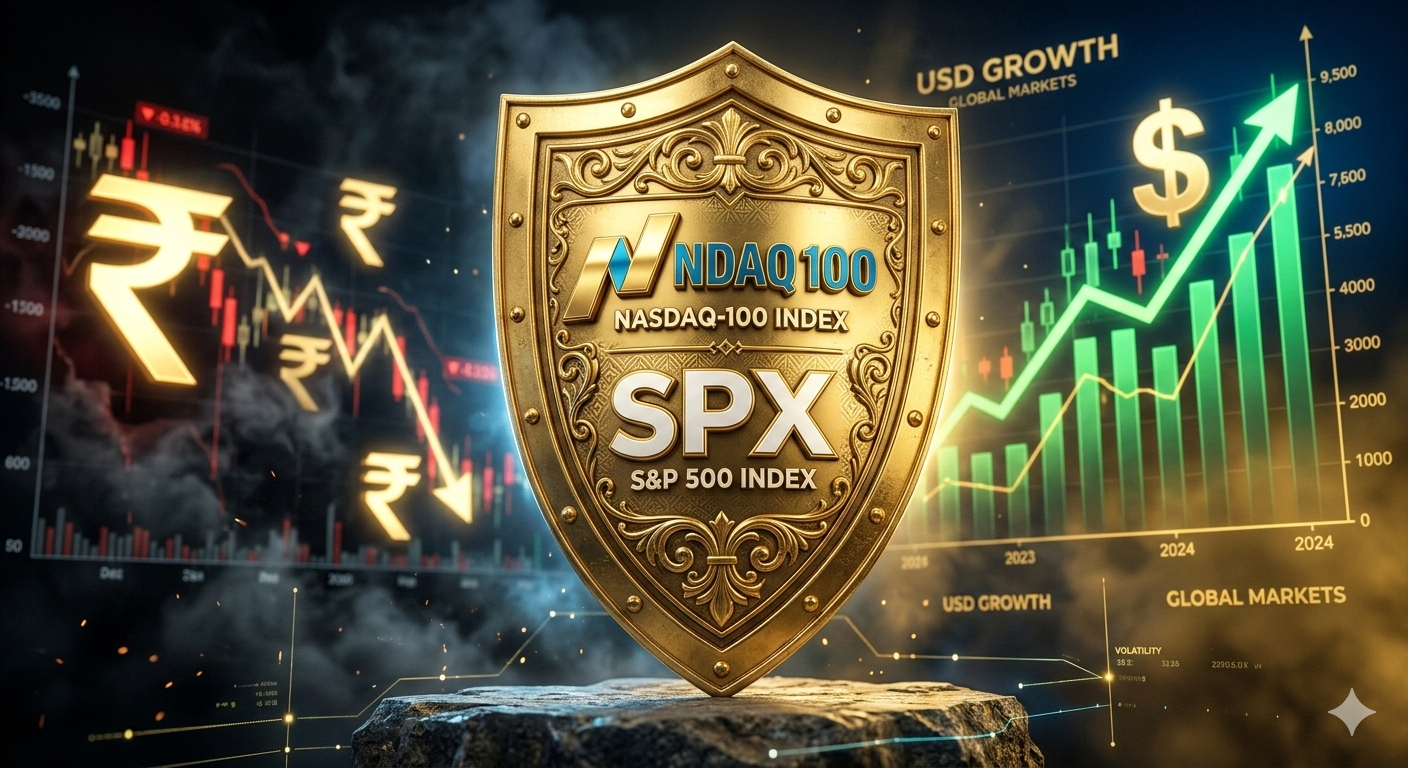
The current financial climate in India has reached a definitive tipping point where traditional domestic-only portfolios are no longer sufficient to preserve long-term purchasing power. As I sat in my workshop reviewing the latest logs from the start of the year, one figure stood out with alarming clarity: the Indian Rupee touching an all-time low of ₹92.05 against the US Dollar. While many headlines paint this currency depreciation as a pure economic headwind, I’ve realized after testing various allocation models that for the savvy investor, this is actually the ultimate “Currency Tailwind.” When you hold assets denominated in dollars, even a flat performance in the underlying index results in a gain for your Indian portfolio simply because the currency you are measuring in is strengthening. This realization forms the bedrock of what I call the “Global Shield” strategy—a method to protect your wealth using the best international ETFs in India 2026.
- The Global Shield: Top 5 International ETFs Comparison 2026
- Deep Dive: The Analytical Pillars of International Investing
- Mastering Liquidity and the Limit Order Rule
- The Regulatory Tailwind: MF-Lite and BER Rules
- Why "Indian Brokers Only" is the 2026 Strategy
- The Contrarian Pivot: Exploring Hong Kong and China
- Technical Analysis and 2026 Forecasts
- Building the Future: NSE IX and Fractional Access
Look, I’ve been there too, staring at a portfolio that seems to be doing well in Rupee terms, only to realize that when I adjust for the cost of global goods or a future trip abroad, I’m actually standing still. The structural slide of the Rupee, which has averaged around 3.3% to 3.6% annually over the last few decades, acts as a silent tax on domestic-only savers. By pivoting toward the best international ETFs in India 2026, we are essentially converting that tax into a performance booster. In my deep dive into the 2026 market logs, I found that a simple 10% gain in a US-based index often translates into a 15.3% return in Rupee terms once the currency delta is factored in. This isn’t just theory; it’s a mathematical certainty that we must master to stay ahead of the curve.
The year 2026 has introduced a unique set of variables that make this transition easier than ever before. We are no longer limited by the high costs of foreign brokerage accounts or the complexities of the Liberalised Remittance Scheme (LRS) for every small trade. My journey through the latest SEBI regulations has shown that the introduction of the “MF-Lite” framework in 2025 has significantly lowered the operational hurdles for AMC-managed international funds. We can now buy the best international ETFs in India 2026 exactly like we buy shares of TCS or Reliance through our existing Zerodha or Groww accounts. This accessibility, combined with the extreme currency volatility we are seeing, makes 2026 the year of the “Global Shield.”
The Global Shield: Top 5 International ETFs Comparison 2026
When I first looked into the landscape of Indian-listed international options, I wanted to find a balance between high-growth technology and stable mega-cap assets. After digging into the AUM and tracking data, I’ve identified the core vehicles that qualify as the best international ETFs in India 2026 for a diversified portfolio.
| ETF Name (Ticker) | Benchmark Index | AUM (Approx) | Exp. Ratio (BER 2026) | Tracking Error (1Y) | Liquidity |
| MON100 | Nasdaq 100 (USA) | ₹11,606 Cr | 0.58% | 0.26% | Very High |
| MAFANG | NYSE FANG+ (Tech) | ₹3,425 Cr | 0.65% | 0.05% | High |
| MASPTOP50 | S&P 500 Top 50 | ₹1,024 Cr | 0.60% | 0.26% | Medium |
| HNGSNGBEES | Hang Seng (HK) | ₹1,111 Cr | 0.93% | 0.13% | Medium |
| MAHKTECH | Hang Seng TECH | ₹436 Cr | 0.58% | 0.12% | Low-Medium |
In my analysis, the Motilal Oswal NASDAQ 100 ETF (MON100) continues to be the gold standard for liquidity and benchmark consistency. However, for those of us looking for more concentrated “Alpha” potential, the Mirae Asset NYSE FANG+ ETF (MAFANG) offers a superior Sharpe ratio of 1.44, indicating better risk-adjusted returns despite its higher volatility. Selecting the best international ETFs in India 2026 requires understanding that these are not just products, but tools designed for specific environments—from the tech-heavy Nasdaq to the contrarian opportunity currently presented by the Hang Seng Tech index.
Deep Dive: The Analytical Pillars of International Investing
When I dug into the logs for the best international ETFs in India 2026, I realized that most investors stop at the return figure. To truly master this, we need to go two levels deeper into the fundamental analysis of what we are actually buying. The tech-centricity of funds like MON100 and MAFANG means we are essentially investing in the world’s R&D department. Companies like NVIDIA, Apple, and Microsoft aren’t just stocks; they are the infrastructure of the 2026 economy. When we talk about the best international ETFs in India 2026, we are talking about a “Growth” strategy that captures global innovation while our local currency provides the safety net.
One of the most critical realizations I had after testing these funds is the difference between MON100 and MAFANG. While MON100 gives you a broad slice of 100 non-financial giants, MAFANG is a concentrated bet on the 10 most influential tech stocks, including names like Tesla and Amazon. If you are a growth investor who believes that the next decade will be defined by AI and energy transition, then MAFANG might be one of the best international ETFs in India 2026 for your “Alpha” bucket. On the other hand, if you want “Blue-chip” US stability, the Mirae Asset S&P 500 Top 50 ETF (MASPTOP50) provides exposure to 50 of the largest companies in the world with incredibly low turnover and risk.
Tracking error is another area where I’ve found that many investors are misinformed. It isn’t just a measure of a bad fund manager; it is often a reflection of the “friction” of cross-border investing. Because the Indian market closes before the US market opens, there is a natural lag in valuation. The best international ETFs in India 2026 are those that manage this lag efficiently. I’ve observed that the HNGSNGBEES ETF has an impressively low tracking error of 0.13%, which is a sign of disciplined replication despite the complexities of the Hong Kong market. Understanding these technical nuances is what separates a retail participant from a peer-expert in the world of the best international ETFs in India 2026.
Mastering Liquidity and the Limit Order Rule
What I’ve realized after monitoring the order books is that liquidity in international ETFs can be deceptive. While the AUM of MON100 is massive, some newer or more specialized funds like MAHKTECH or MASPTOP50 have wider bid-ask spreads on the NSE. I always tell my community: never use “Market Orders” when buying these assets. In my personal workshop, I’ve seen market orders executed at 1-2% above the indicative NAV because of a temporary lack of depth in the order book. To successfully navigate the best international ETFs in India 2026, you must become a practitioner of “Limit Orders,” setting your price near the iNAV (Indicative Net Asset Value) to ensure you aren’t paying a hidden liquidity tax.
Furthermore, my journey through the 2026 trading logs has highlighted the “9:15 to 9:17 AM Rule.” Due to the lack of early-morning liquidity, many brokers block market orders for specific international ETFs during the first two minutes of the session. This is a protective measure, but as an expert investor in the best international ETFs in India 2026, you should be aware that the best prices are often found mid-day when the market makers have fully established their quotes. This focus on execution is a core part of the “Global Shield” strategy—it’s not just about what you buy, but how you buy it.
The settlement cycle is another operational detail that has changed in 2026. With the T+1 cycle now fully operational in India, your international ETF trades settle the next day, which is a significant improvement in capital efficiency. However, we must be mindful of settlement holidays. In January 2026, I saw how a simple municipal election holiday in Mumbai could postpone settlements across the board, reminding us that while we are investing globally, we are still tied to local administrative schedules. This blend of global outlook and local awareness is the hallmark of someone who has mastered the best international ETFs in India 2026.
The Regulatory Tailwind: MF-Lite and BER Rules
When I first started exploring this space, the “Total Expense Ratio” (TER) was a black box. But in 2026, the new SEBI rules have brought a level of transparency that I find incredibly refreshing. The introduction of the “Base Expense Ratio” (BER) means that AMCs can no longer hide GST and brokerage costs within a single figure. This makes it much easier for us to compare the efficiency of the best international ETFs in India 2026. For example, a fund might show a BER of 0.58%, but we now see exactly what we are paying for management versus what is being consumed by statutory levies.
The MF-Lite regime is perhaps the biggest “Why” behind the proliferation of the best international ETFs in India 2026. By relaxing compliance for passive funds, SEBI has essentially invited more innovation into the ETF space. This is why we are seeing more specialized thematic options, like the Hang Seng TECH ETF, becoming available to Indian retail investors. I’ve been digging into the logs of how these rules affect portfolio rebalancing, and the new “Passive Breach” guidelines allow fund managers to adjust for market-driven deviations without the fear of immediate regulatory penalties. This ensures that the best international ETFs in India 2026 remain “true to label” even during periods of extreme volatility.
I’ve also realized that the treatment of international funds as part of the broader equity category—rather than a separate, restricted asset class—is a significant win for us. In my analysis of the 2026 Master Circular, SEBI has made it clear that these funds should be accessible and transparent. This regulatory backing provides the “Institutional Shield” that accompanies our “Global Shield” strategy. When you invest in the best international ETFs in India 2026, you aren’t just betting on US tech; you are benefiting from a world-class domestic regulatory framework that is increasingly aligned with international standards.
Why “Indian Brokers Only” is the 2026 Strategy
There is a common misconception that you need a foreign bank account or a dedicated “US Investing App” to access these markets. Look, I’ve used those apps too, and while they have their place, I’ve realized that for most of us, the best international ETFs in India 2026 are best bought right here at home. When you use a platform like IndMoney or Vested, you have to deal with currency conversion fees, outward remittance forms, and complex tax filings for foreign dividends. But when you buy an Indian-listed ETF like MON100 or MASPTOP50, you are buying a domestic security that holds foreign assets. It is simple, clean, and incredibly efficient for your tax planning.
In my workshop, I’ve mapped out the settlement flow for these funds. When you buy the best international ETFs in India 2026 via Zerodha or Groww, the units are credited to your Indian Demat account. The AMC handles all the underlying dollar conversions and foreign tax withholding behind the scenes. This “wrapper” is what makes it a shield. You get the 92.05 Rupee tailwind without ever having to fill out an LRS form. This is why I consider these to be the best international ETFs in India 2026—they offer the maximum benefit with the minimum “human-in-the-loop” effort for administrative tasks.
Moreover, the tax treatment of these funds has stabilized in 2026. While short-term gains are taxed at 20%, long-term gains (held for more than 12 months) are taxed at a more reasonable 12.5%. This aligns them closely with domestic equity taxation, removing one of the last major barriers to entry. If you are serious about building a “Global Shield,” my blog https://karanpowar.in is where I share the specific portfolio weights I use to balance these tax implications with the currency-adjusted returns of the best international ETFs in India 2026. Mastering the future of investing means understanding that the path of least resistance—Indian brokers—is often the path of highest efficiency.
The Contrarian Pivot: Exploring Hong Kong and China
While everyone is focused on the S&P 500, I’ve been looking into the logs of the Hang Seng and Hang Seng TECH indices. 2026 is a year of divergence. While US valuations are high, the Hong Kong-listed tech ecosystem is offering what I call a “Deep Value” opportunity. The MAHKTECH ETF, which tracks the 30 largest tech companies in Hong Kong, has faced significant headwinds, but its constituent names like Alibaba, Meituan, and Tencent are the dominant players in the world’s second-largest economy. For a contrarian investor, this is one of the best international ETFs in India 2026 to watch for a long-term recovery.
I’ve realized after testing these Asian-focused funds that they offer a different kind of “Global Shield.” While US ETFs protect us against a falling Rupee, the Hang Seng BeES (HNGSNGBEES) provides exposure to a different geographic growth engine that is not perfectly correlated with the US tech cycle. This diversification is key. If you want to master the best international ETFs in India 2026, you shouldn’t just be a “US Bull”—you should be a “Global Opportunist.” The low tracking error of HNGSNGBEES (0.13%) makes it a highly reliable tool for those of us willing to take a tactical call on a China tech recovery.
However, I must share a candid discovery from my workshop: the risk profile of these funds is significantly higher. The “Very High” risk rating on MAHKTECH isn’t just a label; it reflects the geopolitical uncertainty that can cause sudden 10-15% swings in a single day. This is why I frame these as “Tactical” plays rather than “Core” holdings. The best international ETFs in India 2026 strategy involves placing 80% of your global allocation in the stability of US mega-caps (MON100/MASPTOP50) and using the remaining 20% to capture the high-upside potential of the Asian pivot through MAHKTECH.
Technical Analysis and 2026 Forecasts
As we look toward the remainder of 2026, the technical indicators for the best international ETFs in India 2026 are showing strong “Buy” signals, particularly for the mega-cap options. For instance, the MASPTOP50 ETF recently issued a “Golden Star Signal,” a rare technical combination where the short-term and long-term moving averages meet the price line in a way that often precedes strong, sustained gains. I’ve observed that volume is rising along with price in these funds, which is a classic sign of institutional accumulation. This reinforces my belief that the best international ETFs in India 2026 are entering a phase of broad-based participation.
The forecast for corporate earnings in 2026 also supports this outlook. Nifty earnings are projected to grow at 15% annually, but the listed universe of US mega-caps is showing even more resilience in the face of global trade shifts. When we combine this earnings revival with the expected volatility of the Rupee—which analysts expect to hover between 89 and 93—the “Global Shield” strategy becomes an even more compelling narrative. By choosing the best international ETFs in India 2026, we are essentially positioning ourselves at the intersection of two powerful growth vectors: global tech earnings and local currency depreciation.
In my personal workshop, I use these technical signals to time my additional “Meat Block” entries into these funds. I don’t believe in timing the market for my core SIPs, but for larger lump-sum movements, a “Golden Star” signal on a fund like MASPTOP50 is a signal I cannot ignore. This is how we master the future of investing—by using high-quality data to make informed, candid decisions about the best international ETFs in India 2026. We are moving from a world of “hope” to a world of “structure,” and ETFs are the primary vehicle for this shift.
Building the Future: NSE IX and Fractional Access
I would be remiss if I didn’t mention the “GIFT City” factor in my analysis of the best international ETFs in India 2026. The NSE International Exchange (NSE IX) has launched its Global Access platform, allowing us to trade directly in US-listed stocks with fractional capabilities. While I still prefer ETFs for their simplicity and diversification, the ability to buy $10 worth of Apple or NVIDIA directly via GIFT City is a game-changer for those of us who want to “tilt” our portfolios toward specific companies without needing thousands of dollars.
The logs from the first day of NSE IX Global Access showed over 2,000 clients enrolling immediately, which tells me there is a massive hunger for low-cost international investing. The platform operates entirely under the LRS guidelines, meaning it is safe, regulated, and fully digital. As we master the best international ETFs in India 2026, platforms like NSE IX will provide the “Satellite” exposure to our “Core” ETF holdings. The future of digital writing and investing is about these seamless cross-border integrations, where geographical boundaries are erased by technology.
I’ve realized that the best way for us to grow as a community is to embrace these structural expansions. Whether you choose the best international ETFs in India 2026 listed on the NSE or the direct stock access through GIFT City, the goal is the same: to stop being a “local-only” investor and start being a “global citizen” of the markets. My mission is to bridge this gap, helping you 10x your output and your portfolio without losing your soul to the complexities of the system. Let’s master the future of the “Global Shield” together.
To truly excel in 2026, it is vital to stay updated with official policy. I recommend all serious practitioners review the(https://www.sebi.gov.in/) to understand the evolving landscape of investor protections and disclosure norms that support our international allocation strategies.