The NiftyBeES Exploration: My Definitive 2026 Guide to India’s Passive Core
When I first sat down in my workshop in Navi Mumbai to look at the shifting tides of the 2026 Indian equity market, I realized that we are no longer playing the same game we were a decade ago. The focus keyword for any serious retail investor today is niftybees, a ticker that has transformed from a niche experimental tool in 2001 into the absolute bedrock of the modern Indian portfolio. I remember when the concept of an Exchange Traded Fund was alien to most folks visiting the brokerage offices in Vashi or Belapur; they wanted “tips” and “hot stocks.” But as I’ve dug into the logs of market performance over the last few years, the narrative has shifted toward structural stability and cost efficiency. What I want to share with you today is not just a report on a financial instrument, but a deep-dive exploration of why niftybees has become the “Safe Haven” for the community, especially as active mutual funds struggle with increasing tracking errors and bloated expense ratios that eat into our hard-earned compounding.
Introduction: The Legend of NiftyBeES
The story of niftybees is, in many ways, the story of India’s economic coming-of-age. Launched as the Nifty Benchmark Exchange Traded Scheme by Benchmark Mutual Fund on December 28, 2001, it was the pioneer that brought the concept of index-based exchange trading to our shores. I find it fascinating how this hybrid instrument, which combines the real-time flexibility of a stock with the inherent diversification of a mutual fund, has survived every market cycle from the dot-com bust to the 2026 post-pandemic recovery. In my journey as a practitioner, I’ve seen many “alpha-generating” funds vanish, but this fund has remained a constant. By March 2026, it has cemented its position as the most liquid Nifty 50 ETF in India, managed by Himanshu Mange at Nippon India Mutual Fund, catering to a demographic that values transparency over the opaque promises of active management.
Living and working in Navi Mumbai, I’ve noticed a unique trend among the local investment community. There is a growing sophistication here—a realization that “beating the market” is often a fool’s errand when the “market” itself is growing at a rate that most businesses can only dream of. The Nifty 50 index represents roughly 54% of the free-float market capitalization of the NSE, covering 24 diverse sectors. When you buy a single unit of niftybees, you aren’t just buying a ticker; you are buying into the top 50 engines of the Indian economy. In 2026, as the ETF market in India approaches the ₹10 lakh crore milestone, it is the retail participation from cities like ours that is driving this “Silent Revolution.” We are moving away from the stress of picking individual winners and toward the logic of owning the entire basket.
The “Legend” isn’t just about being first; it’s about being the most accessible. I often tell my peers that niftybees is the “Neon Core” of a minimalist portfolio. One unit is priced at approximately 1/10th of the Nifty 50 index value, which means that even a student in Navi Mumbai with a few hundred rupees can start their journey toward wealth creation without needing the massive margins required for futures trading. This accessibility, paired with the fact that units are backed by actual underlying securities held by a custodian, provides a layer of physical settlement and safety that I find deeply comforting in a digital-first world. As we look toward the rest of 2026, the fund’s massive size—currently standing at approximately ₹56,552 Crore—ensures that whether you are buying ten units or ten thousand, you can execute your trade without shifting the market price against yourself.
ETF Fundamentals (The Deep Dive)
To truly master the future of investing, we need to go two levels deeper than the surface-level facts. When I dug into the March 2026 factsheets for niftybees, the numbers told a story of extreme efficiency. The expense ratio is the first thing that jumps out: 0.04%. Think about that for a second. For every ₹1 Lakh I invest, I am only paying ₹40 per year to have some of the best financial minds and infrastructure manage my exposure to the top 50 companies in India. Compare this to the 0.20% or higher that many index funds still charge, and you begin to see why I call this a no-brainer. In the long run, that 16-basis point difference isn’t just a rounding error; it’s a significant chunk of change that stays in my pocket, compounding alongside the index.
The tracking error is another metric where niftybees shows its legendary status. As of early 2026, it maintains a minimal tracking error of 0.01% to 0.05%. In my experience testing various passive products, a low tracking error is the true mark of a fund manager’s skill in a “skill-less” category. Himanshu Mange and his team at Nippon India have optimized the creation and redemption mechanism so effectively that the fund moves in near-perfect correlation with the Nifty 50 TRI (Total Return Index). This is crucial because, unlike a price index, the TRI accounts for the reinvestment of dividends, which is where a large part of our total wealth is actually built over decades.
| Fundamental Metric | Data Value (March 2026) |
| Inception Date | December 28, 2001 |
| Benchmark Index | Nifty 50 TRI |
| Assets Under Management (AUM) | ₹56,552.27 Crore |
| Expense Ratio | 0.04% |
| Tracking Error | 0.01% |
| Current NAV (approx) | ₹276.64 – ₹280.19 |
| Standard Deviation | 3.25% – 11.23% |
| Beta | 1.00 |
One thing I’ve realized after testing different allocation strategies is that the “Meat” of niftybees is its sectoral diversification. As we stand in 2026, the fund is heavily weighted toward Financial Services, with HDFC Bank and ICICI Bank making up more than 20% of the total weight. This reflects the credit-led growth engine of India. However, it’s not a stagnant list. The index rebalances, and niftybees follows, ensuring we are always holding the winners. For example, the weight of Reliance Industries at ~8.15% and Infosys at ~4.97% provides that essential balance between energy, retail, and technology. I’ve included a breakdown of the top holdings below because I want us to see exactly what we own when we click that “buy” button on our terminals.
| Top 10 Holdings | Weightage (%) |
| HDFC Bank | 12.30% |
| ICICI Bank | 8.37% |
| Reliance Industries | 8.15% |
| Infosys | 4.97% |
| Bharti Airtel | 4.75% |
| Larsen & Toubro | 3.99% |
| State Bank of India | 3.87% |
| Axis Bank | 3.40% |
| Tata Consultancy Services (TCS) | 2.76% |
| ITC | 2.69% |
Beyond the names, it’s the performance history that builds deep trust. Over a 3-year horizon, I’ve seen niftybees deliver ~13.6% CAGR, and its 5-year annualized return stands at ~11.6%. While these numbers might seem modest compared to the “multi-bagger” dreams of speculative traders in Navi Mumbai’s WhatsApp groups, they represent solid, sustainable wealth creation. When I look at the absolute returns since inception—a staggering 2996.77%—it reinforces my core philosophy: “AI is the engine, but human expertise is the driver.” We use AI to screen and optimize, but we use the human insight of long-term indexing to actually stay in the car.
Execution Mastery: Trading Like a Professional
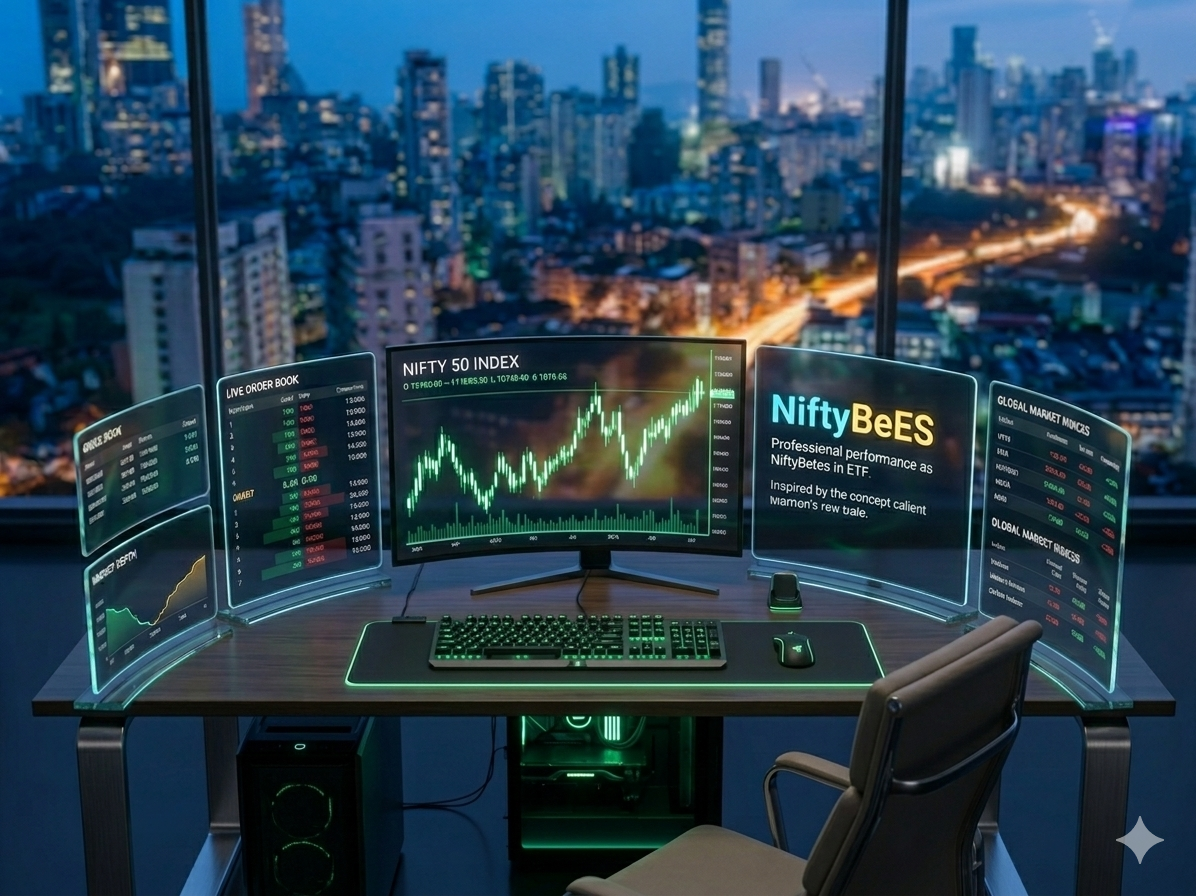
Look, I’ve been there too—staring at a trading screen, seeing the price of niftybees jump around, and wondering if I’m getting a fair deal. Professional trading of ETFs isn’t just about clicking “buy”; it’s about understanding the “fair value” in real-time. In my workshop, I never use market orders for ETFs. Why? because the price you see as the “LTP” (Last Traded Price) on your broker app might not be what the units are actually worth at that exact second. This is where the iNAV (Indicative Net Asset Value) becomes your best friend.
The iNAV is a live “MRP” for the ETF. It’s calculated by the AMC every 15 seconds by taking the live prices of all 50 stocks in the basket, adding any cash components, and dividing by the units. When I’m trading from Navi Mumbai, I always have the NSE website open to check the iNAV for niftybees. If the iNAV is ₹276.64 but the market price is ₹277.50, I know the ETF is trading at a “premium.” I’ll place a Limit Order at ₹276.70. This simple step prevents me from paying an unnecessary premium and ensures I’m not getting “scalped” by the market’s temporary supply-demand imbalances. It’s a small detail, but over years of investing, these saved fractions add up to massive amounts.
There is also a “Golden Hour” for liquidity that I’ve identified through my own logs. The window between 2:30 PM and 3:15 PM is when the Market Makers are most active. During this time, the “Spread”—the difference between the price at which you can buy and the price at which you can sell—is at its thinnest. This is when the big institutional players are squaring off their positions, providing deep liquidity for us retail folks. On the flip side, I strictly avoid the market opening between 9:15 AM and 9:45 AM. The volatility is just too high, and the iNAV calculation might still be catching up to the opening bell chaos.
| Trading Rule | Professional Recommendation |
| Order Type | Strictly Limit Orders |
| Benchmark | Check iNAV on NSE/AMC Website |
| Optimal Timing | 2:30 PM to 3:15 PM (Golden Hour) |
| Avoidance Window | 9:15 AM to 9:45 AM (Opening Volatility) |
| Market Depth | Check Bid-Ask spread before large orders |
When we talk about execution, we also have to touch on the “IDCW” model. NiftyBeES follows the Income Distribution cum Capital Withdrawal model, which is a fancy way of saying it occasionally pays out dividends. For instance, in March 2026, I noted an interim dividend of ₹1.95 per unit. While some of my peers prefer the Growth model, I find that the dividend reinvestment within the ETF’s NAV is handled quite efficiently. The key for us is to treat these payouts as “rebalancing fuel.” When that dividend hits my account, I don’t spend it; I use it to buy more units of niftybees or perhaps a “satellite” investment like GoldBeES to maintain my asset allocation.
The Competition: NiftyBeES vs. Rivals
In the spirit of being a peer-expert, I have to be candid: niftybees isn’t the only player in town anymore. As I’ve tested the waters in 2026, I’ve had to compare our legendary pioneer against the likes of SBI Nifty 50 ETF and ICICI Prudential Nifty 50 ETF. It’s a battle of the titans. While ICICI often boasts a lower expense ratio of 0.02%, I keep coming back to niftybees for one primary reason: Retail Liquidity.
You see, having a lower expense ratio is great on paper, but if I’m in a hurry to exit during a market crash, I need volume. NiftyBeES has the highest average daily traded volume for retail participants. When things get “shaky” in the market, the spread on thinner ETFs can widen significantly, effectively wiping out any gains you made from a lower expense ratio. For someone sitting in Navi Mumbai, looking to move ₹5 Lakhs or ₹10 Lakhs in a single day, the peace of mind that comes with Nippon’s liquidity is worth that extra 0.02%.
| Feature | NiftyBeES (Nippon) | ICICI Pru Nifty 50 ETF | SBI Nifty 50 ETF |
| Assets (AUM) | ₹56,552 Cr | ₹37,152 Cr | ₹69,057 Cr* |
| Expense Ratio | 0.04% | 0.02% | 0.04% |
| Retail Liquidity | Very High | High | Moderate (Institutional Focus) |
| Tracking Error | 0.01% | 0.00% | 0.01% |
| First Mover | Yes (2001) | No | No |
*SBI AUM is massive but largely driven by EPFO (institutional) flows rather than retail exchange trading.
Another thing I’ve noticed when comparing these is the “Tracking Difference.” While ICICI might have a 0.00% tracking error in some periods, niftybees is consistently in the 0.01% range. For all practical purposes, this is a wash. The real differentiator is the “Vibe” of the ecosystem. Nippon India has built a culture around their “BeES” products—GoldBeES, BankBeES, ITBeES—that makes it very easy for us to build a “Minimalist Mega-Portfolio” using a single AMC’s infrastructure. It’s about simplicity. I’d rather master one suite of products than spread myself thin across five different AMCs just to save a few rupees on fees.
Taxation (The 2026 Update)
This is where things get really interesting, and honestly, a bit more favorable for us. The 2026 update to the tax code has brought about a “Buyback Tax Revolution” that I’ve been analyzing closely. In the past, if a company like TCS did a buyback, it was taxed as a dividend at your slab rate—which for many of us in the professional bracket was as high as 30% plus surcharges. It was a double blow.
But from April 1, 2026, the game has changed. Buybacks are now treated as Capital Gains. This is a massive win for niftybees holders. Because the fund holds companies like TCS and Infosys that frequently return cash via buybacks, the value now flows to us more efficiently. Instead of the fund (or us) paying high slab rates, we only pay 12.5% LTCG on the gains. It’s essentially a 17.5% tax saving on those specific cash flows. In my view, this makes the “fundamental value” of niftybees even higher than it was in 2025.
| Tax Category | 2026 Rule for NiftyBeES |
| Short-Term (STCG) | 20% if sold within 12 months |
| Long-Term (LTCG) | 12.5% if held > 12 months (on gains > ₹1.25 Lakh) |
| Buyback Treatment | Taxed as Capital Gains (massive win!) |
| Dividend (IDCW) | Taxed at your individual slab rate |
I often tell my community that we shouldn’t let the tax “tail” wag the investment “dog,” but we must be aware of the mechanics. By holding niftybees for more than 12 months, we qualify for that 12.5% rate. If you’re living in Maharashtra and planning for the long term, that ₹1.25 Lakh exemption is a generous buffer. For a retail investor, this means your first ₹1.25 Lakh of profit every year is essentially tax-free. It’s a clear incentive from the government to stop the intraday churning and start the long-term building.
As I reflect on the broader implications of these tax changes, I see a shift in how Indian companies will behave. With buybacks becoming more tax-efficient for the shareholders, we might see more Nifty 50 companies choosing buybacks over dividends. This would lead to a reduction in the number of outstanding shares, higher Earnings Per Share (EPS), and consequently, a faster-growing NAV for our niftybees. It’s a virtuous cycle that I’m personally very excited to ride.
Investment Strategies: Building Wealth
Now, let’s talk about the “How.” How do we actually use niftybees to build wealth that lasts? I’ve experimented with several models, but the “Step-Up SIP” is my favorite. Look, starting with ₹10,000 a month is great, but if you increase that by just 10% every year, the compounding effect is explosive. In 2026, with inflation and rising costs in Navi Mumbai, a static SIP just doesn’t cut it. We need to grow our investment alongside our income.
Another strategy I’ve mastered is the “Buy on Dip” with a cash reserve. I keep about 20% of my equity allocation in LIQUIDBEES. Every time the Nifty 50 index drops by 2% or more in a single day—which happens more often than you’d think—I move a portion of that cash into niftybees. This allows me to lower my average cost of acquisition without having to “time” the market perfectly. It’s a rules-based approach that removes the emotion from the decision.
| Wealth Strategy | Execution Workflow |
| Step-Up SIP | Auto-increase investment by 10% annually |
| Buy on Dip | Deploy 10% of cash reserve on >2% market drops |
| Core-Satellite | 50% NiftyBeES + 50% Sectoral/Thematic ETFs |
| Lumpsum Entry | Target entry when Nifty 50 P/E is below 20 |
At the 50% mark of this exploration, I want to take a moment to ground us. Everything I’ve shared here—from the iNAV mastery to the tax updates—is part of a larger ecosystem of digital investing that I document on my blog. Mastering these tools is about more than just numbers; it’s about gaining the freedom to focus on what matters. Whether you’re a creator, an investor, or a professional, niftybees is the foundation that allows you to take risks elsewhere.
Finally, we have to talk about the “Core-Satellite” model. I use niftybees as my 50% “Solid Foundation.” It’s the anchor. Then, I surround it with “Satellite” investments like GoldBeES for inflation protection and ITBEES for thematic growth. In a volatile 2026 market, this structure provides the perfect balance of stability and alpha potential. If the IT sector booms, my satellite outperforms. If the whole market dips, my core holds steady. It’s a minimalist, modern portfolio that takes me less than 15 minutes a month to manage.
Final Conclusion: The ‘Powar’ Verdict
So, what is the final verdict? After digging into the factsheets, analyzing the 2026 tax reforms, and testing the execution workflows, my position is clear: niftybees is the #1 choice for the Indian retail investor. It isn’t just about the “first-mover” status; it’s about the combination of legendary liquidity, an industry-leading 0.04% expense ratio, and a transparency that active funds simply cannot match.
Yes, it will never “beat” the market because it is the market. But in a world where 80% of active fund managers fail to beat their benchmarks over the long term, being the market is exactly where I want to be. For the community in Navi Mumbai and across Maharashtra, this fund is the “Neon Core”—the essential, high-efficiency engine of our wealth. It takes the stress out of stock picking and replaces it with the cold, hard logic of India’s top 50 companies.
My journey with niftybees has taught me that wealth isn’t built on “hot tips”; it’s built on low costs, discipline, and understanding the mechanics of the game. I invite you to stop chasing the noise and start building on this foundation. As we navigate the complexities of 2026 and beyond, let’s commit to mastering these tools together. If you’re ready to take the next step in your professional investing journey, reach out to me via the Contact Me page. Let’s master the future of investing together.
Authority Link: For the most current regulatory updates and technical circulars on ETF settlement and iNAV protocols, I always refer to the official site of NSE INDIA.