AI Models 2026: The 7 Titans Dominating Your Workflow
The artificial intelligence landscape of 2026 has moved far beyond the “vibe check” era. We are no longer impressed by an AI simply because it can write a poem; we now demand Specialized Reasoning and Agentic Autonomy. This means AI models 2026 can now solve multi-step problems, manage entire projects, and work for 20–30 minutes without a human needing to click “continue.”
I have seen that “ranking” in 2026 is no longer just about keywords. It is about AI Visibility—ensuring that these “Titans” cite your brand as a trusted source. To do this, you must understand how each model works and what tasks they excel at. Whether you are a developer, a researcher, or a business owner, your choice of model will define your productivity this year.
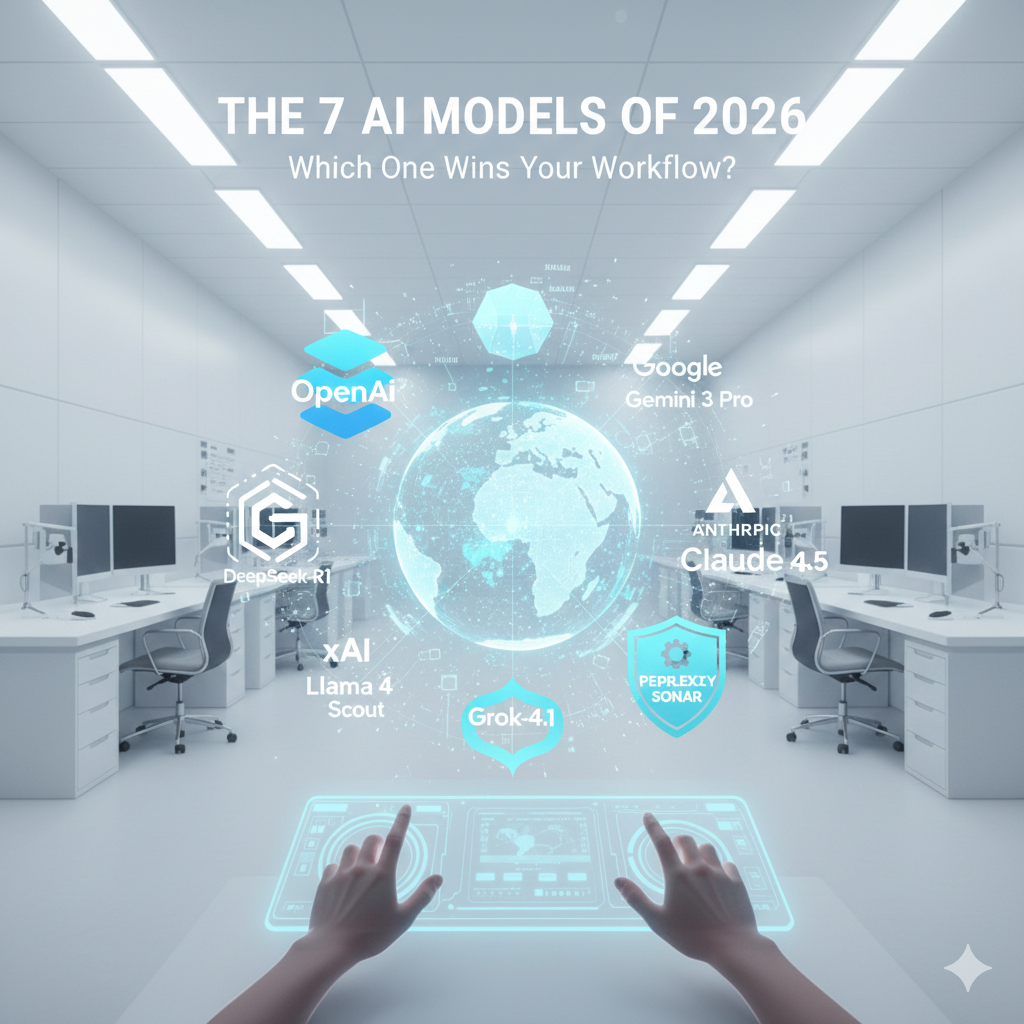
- OpenAI GPT-5.2: The Professional Expert
- Google Gemini 3 Pro: The Research Synthesizer
- Anthropic Claude 4.5 Opus: The Master Coder
- DeepSeek-R1: The Math and Logic Specialist
- xAI Grok-4.1: The Real-Time News Source
- Perplexity Sonar: The Evolution of Verifiable Search
- Meta Llama 4 Scout: The Private Knowledge Base
- Conclusion: Strategic Implementation for AI Models 2026
OpenAI GPT-5.2: The Professional Expert
() is widely regarded as the most reliable model for high-stakes professional artifacts. Known as “The Auditor,” it uses a unique Thinking Mode to simulate logical outcomes and verify facts before delivering a response. This model has effectively solved the “mental math” errors of previous generations, achieving a perfect 100% on the AIME 2025 math competition and scoring 93.2% on graduate-level science benchmarks.
Best Tasks:
- Professional Documentation: Creating boardroom-ready spreadsheets, financial models, and legal reports that are functionally ready for submission.
- High-Stakes Reasoning: Solving PhD-level chemistry or physics problems where even a small error could be costly.
- Decision Support: Acting as a rigid reviewer for complex business strategies and identifying subtle logic gaps.
Google Gemini 3 Pro: The Research Synthesizer
is the world’s most advanced natively multimodal engine, capable of processing text, audio, images, and video in a single pass. Its standout feature is the stable 1-million-token context window, allowing it to “read” or “watch” massive amounts of information simultaneously to find hidden insights. Because it is deeply integrated with the Google Search ecosystem, it excels at generating expertly researched reports using live web data.
Best Tasks:
- Deep Research: Scanning thousands of customer reviews, social media posts, or research papers all at once to find specific pain points.
- Multimedia Analysis: Summarizing hours of raw video footage or professional-grade audio natively without needing transcripts.
- Large-Scale Synthesis: Navigating and refactoring entire code repositories (up to 30,000 lines) in one go.
Anthropic Claude 4.5 Opus: The Master Coder
is known as “The Architect” because of its superior ability to handle long-term goals and complex, multi-system planning. It is currently the top-performing model on the SWE-bench Verified benchmark, fixing real GitHub issues with an 80.9% success rate. Developers prefer Opus for its “human-like” nuance—it understands what you meant to say, not just what you typed.
Best Tasks:
- Software Engineering: Building entire software features and fixing multi-file bugs autonomously using tools like Claude Code.
- Architectural Planning: Designing the structure for new business systems or software projects while maintaining strict goal consistency.
- Nuanced Writing: Drafting 10–15 page chapters of fiction or deep-dive articles that require a sophisticated, consistent “voice.”
DeepSeek-R1: The Math and Logic Specialist
() represents a massive shift in AI efficiency. Built using Reinforcement Learning-First (RL-First) training, it has developed an “innate” ability to reason through logical puzzles and technical math. It is a “Disruptor” because it delivers logic-heavy performance that rivals the most expensive models while maintaining a highly efficient architecture.
Best Tasks:
- Technical Problem-Solving: Solving advanced math, theoretical physics, and engineering challenges that require step-by-step logic.
- Competitive Programming: Excelling in algorithmic coding challenges, outperforming over 93% of human participants in competitions.
- Secure Local Reasoning: Using its open-weight versions to run high-performance AI on your own servers to keep data 100% private.
xAI Grok-4.1: The Real-Time News Source
is the only major model with a direct, real-time link to the X (Twitter) data stream, which it calls the “Global Consciousness.” It is designed to be witty, unfiltered, and emotionally aware, adjusting its tone based on the user’s mood. With a 2-million-token window and the power of the Colossus GPU cluster, it is the premier tool for understanding world events as they happen.
Best Tasks:
- Live Trend Analysis: Explaining why a market shift or news event is happening in real-time by analyzing thousands of live posts.
- Witty Creative Content: Writing scripts, jokes, or creative posts with a “rebellious” and edgy personality that other models might avoid.
- Massive File Comparison: Using its 2M token window to compare years of legal cases or the entire documentation of a complex kernel.
Perplexity Sonar: The Evolution of Verifiable Search
() has transformed from a search engine into a “Conversational Research Assistant.” Its Sonar models prioritize “grounded” answers, meaning every sentence must be backed by a clickable citation. Through its Model Council feature, users can run queries across multiple frontier models (GPT, Claude, Gemini) at once to find a reliable consensus.
Best Tasks:
- Fact-Checking: Instantly verifying the truth behind a claim by searching the latest web data and provide links to the source.
- Strategic Analysis: Using the Model Council to get balanced views on stocks or financial decisions where model bias could be expensive.
- Sourced Drafting: Creating initial summaries or reports for academics and journalists that require high citation density.
Meta Llama 4 Scout: The Private Knowledge Base
() is the champion of the open-weights movement, offering an unprecedented 10-million-token context window. This allows users to keep an entire library of private business data in the model’s “active memory” without ever sending that information to a third-party cloud server. It is the frontier of local AI, providing GPT-4 level intelligence on a single high-end GPU.
Best Tasks:
- Private Enterprise Analysis: Analyzing 15,000 pages of private contracts or research files locally on your own hardware.
- Local Chart/Image Reasoning: Interpreting complex visual data, charts, and technical diagrams with 83–89% accuracy.
- Autonomous Documentation: Keeping a months-long conversational memory for personalized, private assistance.
Conclusion: Strategic Implementation for AI Models 2026
In 2026, the winner of your workflow isn’t just the “smartest” model, but the one that aligns with your professional data intensity and privacy needs. For high-level code and agentic projects, Claude 4.5 Opus is unrivaled. For multimodal research across the Google ecosystem, Gemini 3 Pro is the clear choice.
If you require professional precision and boardroom-ready artifacts, GPT-5.2 remains the Auditor of choice. Meanwhile, DeepSeek-R1 and Llama 4 Scout offer the power of specialized reasoning for those who value economic efficiency and local data sovereignty. As an SEO Specialist, remember: the model you choose will dictate how your brand is cited in the new world of Answer Engine Optimization (AEO).