Artificial Intelligence ETF Landscape for 2026: The Retail Investor’s Guide
The Artificial Intelligence ETF landscape for 2026 has moved far beyond simple software companies. Today, the real opportunity lies in the “picks and shovels”—the data centers, specialized semiconductors, and energy grids that make AI possible. Major tech leaders have tripled their annual spending, pouring over $500 billion into AI infrastructure in 2026 alone.
For retail investors, this means the $25 trillion AI opportunity is moving into the physical world. To help you rank your portfolio for growth, we have broken down the market into five core “Value Chain Factors.”
- Factor 1: The Foundry Layer (Semiconductors)
- Factor 2: The Compute Layer (Data Centers & Cloud)
- Factor 3: The Intelligence Layer (Software & LLMs)
- Factor 4: The Physical Layer (Robotics & Automation)
- Factor 5: The Power Layer (Energy Infrastructure)
- Strategic Conclusion: The 2026 Investment Outlook
- Disclaimer
Factor 1: The Foundry Layer (Semiconductors)
Description: This layer represents the foundational hardware. In 2026, the focus has shifted from general chips to “High Bandwidth Memory” (HBM) and 2nm logic nodes that allow AI to process data faster with less heat. As AI clusters now include hundreds of thousands of chips, the ability to move data between them via “interconnects” is the most critical technical challenge.
Top Artificial Intelligence ETF for 2026:
- SMH (VanEck Semiconductor ETF): Focuses on the top 25 U.S.-listed semiconductor stars. It has delivered a 69.07% return over the last year.
- SOXX (iShares Semiconductor ETF): A broad-based fund providing exposure to the entire U.S. chip industry, up 43% year-to-date.
- SOXQ (Invesco PHLX Semiconductor ETF): A high-performing, low-cost option with an expense ratio of just 0.19%.
The Conviction Shift: In 2024, the goal was just to “get chips.” In 2026, the conviction has shifted toward “System-Level Interconnects.” Investors now prioritize the fiber-optic cables and connectors that allow massive chip clusters to function as a single brain.
Hidden Gem: PSI (Invesco Semiconductors ETF). This fund uses a dynamic index to find mid-cap winners in memory and equipment that larger, market-cap-weighted ETFs often miss
Factor 2: The Compute Layer (Data Centers & Cloud)
Description: AI data centers are the physical “brains” of the industry. Because AI server clusters generate extreme heat, 2026 has seen a boom in prefabricated liquid-cooling solutions that shorten deployment timelines. Data centers in the U.S. now consume more energy than entire states like Ohio.
Top Artificial Intelligence ETF for 2026:
- DTCR (Global X Data Center & Digital Infrastructure ETF): Owns companies that build and manage the real estate for AI. It has gained 23.46% year-to-date.
- SRVR (Pacer Data & Infrastructure Real Estate ETF): A REIT-style ETF that owns the land AI infrastructure sits on, currently offering a 5.22% dividend yield.
- VNQ (Vanguard Real Estate Index Fund ETF): A core way to access the sector with a low 0.13% fee and exposure to data center REITs.
The Conviction Shift: From “Hyperscale Rental” to “Power-Linked Infrastructure.” In 2024, any data center was a win. In 2026, the most valuable sites are those with direct, long-term power purchase agreements (PPAs) that bypass the public grid.
Hidden Gem: AIS (VistaShares Artificial Intelligence Supercycle ETF). This actively managed fund targets the physical “Bill of Materials”—the exact cooling systems and power management units needed for AI centers.
Factor 3: The Intelligence Layer (Software & LLMs)
Description: Software has evolved from simple chatbots to “Agentic AI.” These are autonomous agents that can execute entire workflows—like managing a supply chain or an HR department—without human prompting. This shift is allowing companies to “retire” expensive legacy software licenses, creating a new source of profit.
Top Artificial Intelligence ETF for 2026:
- ARTY (iShares Future AI & Tech ETF): A core fund targeting the full AI value chain, returning 30.25% in the last year.
- CHAT (Roundhill Generative AI & Technology ETF): The first active ETF to focus strictly on the monetization of generative and agentic software.
- IGPT (Invesco AI and Next Gen Software ETF): The longest-running AI software fund, focusing on developers contributing to future software growth.
The Conviction Shift: From “Productivity Tools” to “Autonomous Decision Execution.” Investors are moving away from software that “helps people work faster” toward agents that “do the work” independently.
Hidden Gem: BAI (iShares A.I. Innovation and Tech Active ETF). An actively managed fund that helps investors avoid “tech debt” by picking the newest leaders in the agentic ecosystem.
Factor 4: The Physical Layer (Robotics & Automation)
Description: “Embodied AI” is the trend of 2026. Humanoid robots are moving from the lab to the factory floor, driven by labor shortages and rising costs. The key economic driver here is the actuator (the motor/muscle), which accounts for up to 70% of a robot’s total production cost.
Top Artificial Intelligence ETF for 2026:
- THNQ (ROBO Global Artificial Intelligence ETF): Focuses on the enablers and software that make “Physical AI” possible. It is up 21.6% over the past year.
- BOTZ (Global X Robotics & Artificial Intelligence ETF): The industry standard for robotics, holding global giants in industrial automation.
- KOID (KraneShares Global Humanoid and Embodied Intelligence ETF): A pure-play fund targeting the entire humanoid value chain, including motor and sensor manufacturers.
The Conviction Shift: From “Repetitive Tasks” to “Unstructured Inference.” In 2024, robots were for assembly lines. In 2026, the focus is on robots that can “think” and adapt to messy human environments like hospitals or retail stores.
Hidden Gem: ROBO (ROBO Global Robotics and Automation Index ETF). Provides exposure to specialized component makers in Japan and Europe that the bigger funds often miss.
Factor 5: The Power Layer (Energy Infrastructure)
Description: Energy is the biggest bottleneck for AI today. Hyperscalers are turning to nuclear energy for 24/7 “baseload” power, leading to a “Nuclear Renaissance” in 2026. High-profile deals to restart nuclear reactors have transformed energy from a commodity into a strategic necessity.
Top Artificial Intelligence ETF for 2026:
- NLR (VanEck Uranium and Nuclear ETF): Owns nuclear utilities and miners. It has posted gains of 68% year-to-date.
- POWR (iShares U.S. Power Infrastructure ETF): Targets the grid infrastructure—transmission and storage—that moves power to AI campuses.
- TNUK (Tortoise Nuclear Renaissance ETF): An actively managed nuclear fund that has returned 13.24% in its first month.
The Conviction Shift: From “Commodity Uranium” to “Infrastructure Economics.” In 2024, energy was about fuel prices. In 2026, it is about owning the enrichment capacity and grid reliability that makes AI architecturally possible.
Hidden Gem: URNM (Sprott Uranium Miners ETF). The only ETF providing pure-play exposure to the uranium mining essential for nuclear power fuel.
Strategic Conclusion: The 2026 Investment Outlook
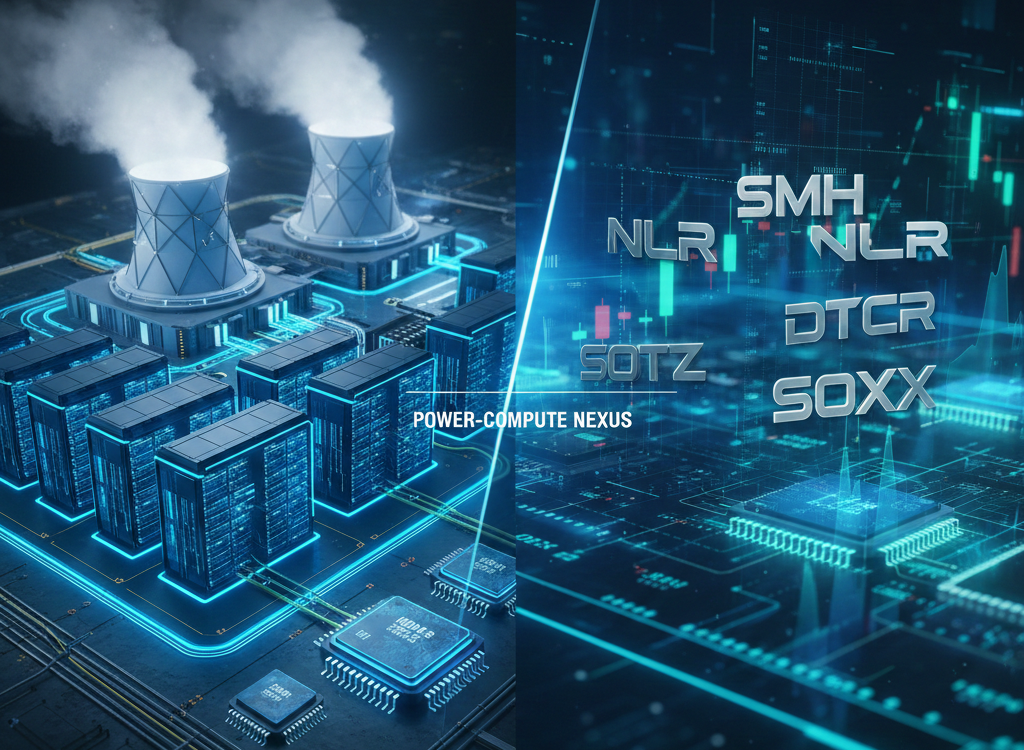
The Artificial Intelligence ETF landscape for 2026 is no longer a speculative bet; it is a structural transformation of the global economy. For retail investors, the takeaway is clear: the most sustainable returns are moving away from simple software apps and toward the physical “Power-Compute Nexus”.
As tech giants continue their $500B+ infrastructure buildout, the companies providing the energy, cooling, and advanced semiconductors are the true pillars of the supercycle. To win in 2026, diversify your portfolio across these five factors, ensuring you own the energy and hardware that makes digital intelligence possible.
For more information on how to invest, visit INDmoney US ETFs.
Disclaimer
Information provided in this report is for educational purposes only and does not constitute financial, investment, or legal advice. Investing in exchange-traded funds (ETFs) involves risk, including the possible loss of principal. Performance data for 2026 is based on current market reports and may fluctuate. Sector-specific ETFs, particularly in the technology and energy sectors, can be subject to higher volatility and regulatory changes. Always consult with a certified financial advisor before making any investment decisions.