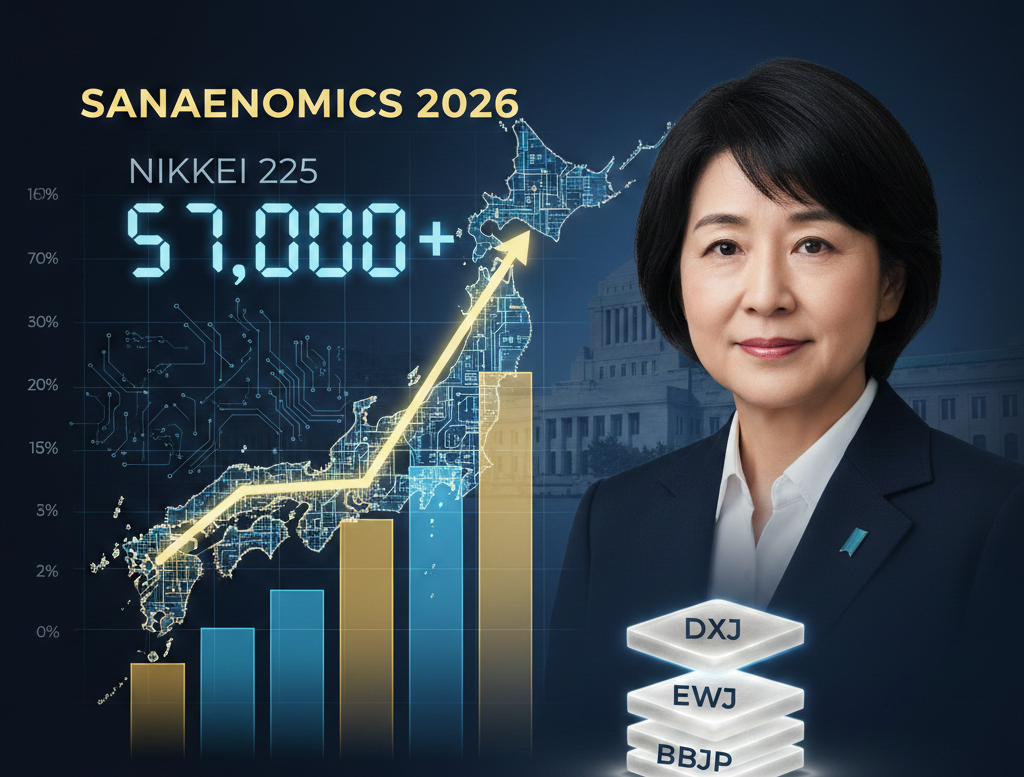
Sanaenomics 2026: Best Japan ETFs for the Takaichi Era
The inauguration of the Takaichi administration in late 2025 marked a definitive turning point for the world’s fourth-largest economy, ushering in a policy regime now universally recognized as Sanaenomics. As the global investment community analyzes the seismic shifts occurring within the Tokyo Stock Exchange, it has become increasingly clear that the “Takaichi Trade” is not merely a short-term momentum play but a fundamental restructuring of the Japanese economic engine. With the Nikkei 225 breaching the 57,000 level following a historic landslide election victory in February 2026, the question for international investors has shifted from whether to allocate to Japan, to how to most effectively capture the upside of this new era. For the sophisticated retail investor and institutional allocator alike, the “ETF Pivot” offers the most robust mechanism to gain exposure to Sanaenomics, mitigating the idiosyncratic risks of individual stock picking while maximizing participation in the broad-based industrial and governance renaissance.
- What is Sanaenomics? The Three Arrows of 2026
- The ¥21.3 Trillion Stimulus: Fueling the Reflationary Engine
- Monetary Policy Normalization: The BOJ’s 1.0% Pivot
- The 17 Strategic Sectors: Building National Indispensability
- The Semiconductor & Defense Surge: Rapidus and Rearmament
- Corporate Governance 2.0: Unlocking the "Idle Cash" Problem
- Top 3 Japan ETFs for 2026: A Comparative Analysis
- Why the "ETF Pivot" Beats Individual Stock Picking
- Geopolitical Dynamics: The China-Japan-US Triangle
- The Road to 2030: Long-Term Growth Projections
- Risk Factors: Fiscal Sustainability and the Carry Trade
- Conclusion: Navigating the New Economic Era
What is Sanaenomics? The Three Arrows of 2026
To understand the current market trajectory, one must first dissect the anatomical components of Sanaenomics. While frequently compared to the Abenomics of the previous decade, the Takaichi platform is uniquely adapted to a post-deflationary world where supply chain resilience and technological sovereignty outweigh simple monetary expansion. The 2026 version of the “Three Arrows” represents a sophisticated evolution of conservative economic thought, designed to navigate a high-interest-rate environment and a “K-shaped” global recovery.
The First Arrow: Monetary-Fiscal Synergy
The first arrow of Sanaenomics addresses the paradigm shift in Japanese central banking. Unlike the aggressive easing of the 2010s, the current regime prioritizes “responsible and proactive public finances” that work in tandem with a normalizing Bank of Japan. The administration acknowledges that the era of zero interest rates has concluded, and instead focuses on ensuring that the BOJ’s 1.0% policy rate does not choke off private sector investment. This synergy is intended to stabilize the Yen while allowing for controlled inflation that supports a virtuous cycle of wage growth.
The Second Arrow: Strategic Fiscal Stimulus
The second arrow is the massive ¥21.3 trillion stimulus package, which serves as the immediate catalyst for the 2026 market rally. This is not “spray-and-pray” spending; it is a targeted allocation of resources toward 17 designated strategic areas. By prioritizing “crisis-management investment,” the government is assuming the role of the lead investor in high-risk, high-reward sectors like nuclear fusion and quantum computing, thereby de-risking these industries for private capital.
The Third Arrow: Structural Reform and Economic Security
The third arrow focuses on “Sovereignty-by-Design.” This involves a comprehensive overhaul of Japan’s industrial policy to ensure that the nation becomes “globally indispensable”. This includes the revision of the National Security Strategy, the creation of a national intelligence agency, and the implementation of the Economic Security Promotion Act to diversify supply chains away from adversarial dependencies. This arrow is the long-term driver of Return on Equity (ROE) improvements across the industrial and technology sectors.
The ¥21.3 Trillion Stimulus: Fueling the Reflationary Engine
The scale of the stimulus package approved by the Takaichi cabinet in late 2025 is unprecedented for a non-recessionary period. Totaling ¥21.3 trillion, the package is structured to address both immediate social pressures and long-term industrial ambitions. This massive injection of capital is the bedrock of the Sanaenomics bull case, providing a “floor” for domestic demand while the global economy faces trade headwinds.
Pillar 1: Cost-of-Living Relief (¥11.7 Trillion)
Nearly 55% of the package is dedicated to stabilizing household finances. This includes the controversial but popular decision to scrap the gasoline tax surcharge and revive energy subsidies to combat the “imported inflation” that battered the middle class in 2024–2025. Additionally, the administration has implemented a two-year suspension of the sales tax on food, a move costing roughly 0.7% of GDP per year but providing a significant boost to consumer sentiment and retail sector earnings.
Pillar 2: Strategic Investment (¥7.2 Trillion)
The core of the growth strategy lies in the ¥7.2 trillion earmarked for priority sectors. This funding is designed to be “proactive and preemptive,” with the government leading investments in semiconductors (Rapidus), AI foundation models, and green transformation (GX). This pillar is expected to catalyze a multi-trillion yen follow-on investment from the private sector as firms regain confidence in Japan’s industrial roadmap.
Pillar 3: Defense and Diplomacy (¥1.7 Trillion)
The final pillar supports the acceleration of Japan’s defense buildup. By channeling ¥1.7 trillion into military modernization, satellite protection, and cybersecurity, Sanaenomics is effectively treating the defense industry as a high-growth technology sector. This spending is integrated with the “shipbuilding revival” policy, creating a synergistic effect between national security and heavy industrial production.
Breakdown of the ¥21.3 Trillion Sanaenomics Stimulus.
| Category | Allocation (¥ Trillion) | Primary Objective |
|---|---|---|
| Cost-of-Living Support | 11.7 | Subsidize energy, scrap gas tax, boost real wages |
| Strategic Investment | 7.2 | Fund Rapidus, AI models, and 17 priority sectors |
| Defense & Security | 1.7 | Boost military tech, cyber defense, and space assets |
| Local Government Grants | 0.7 | Support regional revitalization and childcare |
Monetary Policy Normalization: The BOJ’s 1.0% Pivot
A critical component of the Sanaenomics era is the successful “de-coupling” of Japanese monetary policy from the zero-interest-rate trap. Under Governor Kazuo Ueda, and in close coordination with the Takaichi administration, the Bank of Japan has steered the economy toward a neutral rate environment. In 2026, the policy rate stands at 1.0%, the highest level since the mid-1990s, signaling the definitive end of the “Lost Decades”.
The Real Interest Rate Paradox
Despite the nominal rate hike to 1.0%, the Japanese economy remains fundamentally stimulative. With core inflation persisting at 2.1% (and headline inflation periodically surging higher due to energy costs), the real interest rate in Japan remains negative. This creates a favorable environment for corporate borrowing and capital expenditure, particularly in sectors where Sanaenomics provides direct subsidies.
The End of the Carry Trade?
The 1.0% rate has triggered a gradual unwinding of the Yen carry trade, which historically pressured the JPY. As the Federal Reserve moves toward a terminal rate of 3.0%–3.25%, the yield differential between the US and Japan is narrowing. This convergence is the primary driver of JPY appreciation forecasts, with analysts targeting a range of 140–144 USD/JPY by the end of 2026. For ETF investors, this makes unhedged vehicles like EWJ and BBJP increasingly attractive as they capture both equity gains and currency appreciation.
The 17 Strategic Sectors: Building National Indispensability
The “Master Plan” of Sanaenomics is codified in the designation of 17 priority sectors. These areas are not merely recipients of funding; they are the pillars of a new “Technology-Driven Nation” strategy. Each sector is overseen by a Cabinet minister tasked with formulating a “Roadmap for Public-Private Investment” to be published by the summer of 2026.
High-Growth Technology Clusters
- Semiconductors: Centered on the Rapidus project to produce 2nm logic chips.
- Artificial Intelligence: Development of domestic foundation models and “Physical AI” for robotics.
- Quantum Computing: Leveraging Japan’s strengths in quantum materials and sensors.
- Aerospace & Space: Focus on satellite protection, space-debris removal, and composites.
- Telecommunications: Advancing 6G technology and photonic-electronic convergence.
Economic and Energy Security Clusters
- Next-Gen Nuclear: Accelerating small modular reactors (SMRs) and nuclear fusion.
- Renewables (Perovskite): Utilizing thin-film solar technology developed in Japan to reduce import dependence.
- Critical Minerals: Diversifying supply sources for gallium, germanium, and rare earths.
- Shipbuilding: Revitalizing domestic yards to support maritime sovereignty and supply chains.
- Food Tech & SynBio: Enhancing food security through synthetic biology and plant factories.
Healthcare and Cultural Exports
- Drug Discovery: Streamlining clinical trials and R&D for advanced pharmaceuticals.
- Advanced Medicine: Preventive medicine and regenerative therapies.
- Content Industry: Aggressive global promotion of J-pop, manga, anime, and gaming (Targeting ¥20 trillion in overseas sales).
- Disaster Prevention: Tech-led infrastructure to mitigate earthquake and climate risks.
- Cybersecurity: Defending national critical infrastructure from state-sponsored threats.
- Materials Science: Leveraging Japan’s global dominance in chemical and industrial materials.
- Ocean Development: Utilizing Japan’s Exclusive Economic Zone for resources and energy.
The Semiconductor & Defense Surge: Rapidus and Rearmament
The Takaichi administration has fundamentally redefined Japan’s industrial policy by treating semiconductors and defense as core national infrastructure, triggering a massive wave of capital injection and technological re-alignment. At the heart of this strategy is the state-backed foundry Rapidus, which has received approximately ¥1 trillion in additional funding for the two-year period ending in fiscal 2027, with the Ministry of Economy, Trade and Industry (METI) earmarking ¥630 billion for fiscal 2026 alone to support the pursuit of 2-nanometer logic chip fabrication. This push, part of a cumulative government investment now reaching ¥2.9 trillion, aims for mass production by late 2027 to meet the global surge in demand for AI-ready components and to rebuild domestic capacity after decades of reliance on overseas suppliers. Simultaneously, the defense sector is undergoing a profound structural shift as the government accelerates its pledge to hit a defense-related spending target of 2% of GDP by the end of fiscal 2026, two years ahead of the original schedule. This “defense-as-growth” paradigm is channeling billions into domestic arms production, satellite protection, and cybersecurity infrastructure, while the industry itself moves toward higher-margin, software-driven business models that are expected to expand operating margins by another 120 basis points in 2026. Collectively, these efforts—supported by private backing from giants like Toyota and Sony—are designed to secure Japan’s “strategic indispensability” in global value chains and ensure national resilience against regional geopolitical shifts.
Corporate Governance 2.0: Unlocking the “Idle Cash” Problem
The most profound structural shift in the Japanese market is the transition from “Governance as Compliance” to “Governance as Capital Efficiency.” Sanaenomics has accelerated this trend, viewing corporate reform as a national security imperative to attract global capital.
The Mid-2026 Code Revision
The Financial Services Agency (FSA) is scheduled to release a major revision of the Corporate Governance Code in mid-2026. This “Governance 2.0” focuses on:
- Effective Capital Allocation: Forcing companies to justify holding massive cash balances that historically weighed on ROE.
- Unwinding Cross-Shareholdings: Accelerating the divestment of non-core equity stakes to improve capital transparency.
- Capital Improvement Plans: Nearly 80% of Prime Market companies have now submitted plans to improve their Price-to-Book (P/B) ratios, up from less than 40% in 2023.
The Rise of the Japanese Shareholder
A significant driver of this shift is the expanded Nippon Individual Savings Account (NISA) program. Japanese retail investors, who previously preferred holding cash, are gradually shifting toward riskier assets, particularly domestic equities. This “re-behavioralization” of the Japanese household creates a stable domestic bid for the market, reducing reliance on volatile foreign “hot money”. As corporate earnings grow at 8%–9% annually, more of this profit is being channeled into record share buybacks, expected to hit ¥20 trillion in 2026.
Top 3 Japan ETFs for 2026: A Comparative Analysis
For investors looking to capitalize on Sanaenomics, the choice of ETF is paramount. Each fund offers a different “lens” through which to view the Japanese recovery, with currency hedging being the primary differentiator.
1. WisdomTree Japan Hedged Equity Fund (DXJ)
Strategy: Currency-hedged exposure to dividend-paying Japanese exporters.
- Why Buy in 2026: DXJ is the ideal “Earnings Play.” By neutralizing the JPY/USD fluctuations, investors get pure exposure to the industrial resurgence and the ¥21.3 trillion stimulus effects. If the Yen remains soft (above 150), DXJ will likely continue its streak of outperforming unhedged alternatives.
- Sanaenomics Catalyst: Benefits from export-led growth and the 17 strategic sectors, which are heavily represented in its technology and machinery holdings.
2. iShares MSCI Japan ETF (EWJ)
Strategy: Unhedged, market-cap-weighted exposure to large and mid-cap Japanese stocks.
- Why Buy in 2026: EWJ is the “Currency Recovery Play.” As the BOJ hikes toward 1.0% and the Fed cuts rates, Yen appreciation becomes a major component of total return for US-based investors. EWJ offers superior liquidity and broad exposure to the financials and industrials that anchor the Takaichi growth strategy.
- Sanaenomics Catalyst: Direct beneficiary of the “supermajority” mandate, which reduces political gridlock and enables a faster rollout of growth-focused policies.
3. JPMorgan BetaBuilders Japan ETF (BBJP)
Strategy: Low-cost, unhedged exposure to the broader Japanese equity market.
- Why Buy in 2026: BBJP is the “Core Allocation Play.” With an expense ratio of just 0.19%, it is the most cost-efficient way to maintain a long-term position in Japan. It tracks similar benchmarks to EWJ but at a fraction of the cost, making it ideal for institutional and buy-and-hold retail portfolios.
- Sanaenomics Catalyst: Gains from the overall upward re-rating of the Nikkei and TOPIX indices as global investors return to Japan.
Why the “ETF Pivot” Beats Individual Stock Picking
A recurring theme in the 2026 market is the superior performance of diversified funds over individual stock selection for international investors. This “ETF Pivot” is driven by structural barriers that historically disadvantaged non-local participants.
The Analyst and Language Barrier
Research coverage in Japan remains sparse. The MSCI Japan Index has an average of only 18 analysts per company, compared to 45 for the S&P 500. This information asymmetry means that critical developments in mid-cap strategic sectors often go unnoticed by global markets until after the price has moved. Furthermore, nearly half of all Japanese companies do not disclose earnings in English, effectively locking out non-Japanese-speaking retail investors from deep-value opportunities. ETFs solve this by leveraging the institutional research capabilities of the fund manager.
Liquidity and Execution Risk
In a market defined by “Takaichi Trade” volatility, liquidity is essential. Individual stocks in the 17 strategic sectors (particularly startups in synbio or fusion energy) can suffer from low trading volumes, leading to high slippage and execution costs. ETFs provide “instant diversification,” allowing investors to enter or exit a broad thematic position—like defense or semiconductors—with a single trade, often at lower costs than assembling a basket of individual names.
Geopolitical Dynamics: The China-Japan-US Triangle
Sanaenomics does not exist in a vacuum. It is a geoeconomic strategy designed to navigate the intensifying rivalry between the United States and China.
Strategic Indispensability vs. Strategic Autonomy
Takaichi’s vision for Japan is to be “indispensable” to its allies. Rather than seeking pure autonomy, the administration is focusing on niches—like advanced semiconductor materials, carbon fiber, and optical networks—where the world cannot function without Japanese technology. This approach ensures that even as global trade fragments into competing blocs, Japan remains a vital partner for both the US and Europe.
The “Trump Tariff” and China Tensions
A persistent risk for 2026 is the impact of US trade policy and deteriorating relations with Beijing. The Takaichi cabinet has successfully negotiated a 15% tariff ceiling for most Japanese imports entering the US, a significant improvement over the previous 27.5%. However, China remains a “double-edged sword.” Retaliatory measures by Beijing—such as banning Japanese seafood or restricting minerals—continue to pose downside risks to the manufacturing sector. Sanaenomics addresses this through the “Sovereignty-by-Design” supply chain pillar, subsidizing firms that move production back to Japan or to “friend-shoring” hubs like India and Vietnam.
The Road to 2030: Long-Term Growth Projections
The success of Sanaenomics will ultimately be judged by whether it can lift Japan’s potential growth rate from its historical average of 0.5%. Institutional forecasts for 2026 are optimistic, with GDP expected to expand by 0.7%–1.0% despite the aging demographic headwind.
The AI Productivity Surge
By 2026, the “pilot phase” of AI has matured into “Agentic AI” infrastructure. Japanese firms are leveraging these autonomous systems to fill the labor gap created by a shrinking workforce. This “Agentic Productivity Surge” is expected to contribute an additional 0.3–0.5 percentage points to GDP growth by 2028 as physical AI integrates with Japan’s massive industrial base.
Nominal GDP and Tax Revenues
Nominal GDP has already surpassed ¥600 trillion and is projected to expand by 4% annually as inflation stabilizes in the 2% range. This nominal growth is the “magic bullet” for Japan’s debt sustainability, as it increases tax revenues without necessitating tax hikes—a core promise of the Takaichi administration. If this trend persists, Japan could see its first significant reduction in the debt-to-GDP ratio by the end of the decade.
Risk Factors: Fiscal Sustainability and the Carry Trade
No investment guide is complete without a sober analysis of the risks. Sanaenomics is, at its heart, a high-stakes gamble on growth over austerity.
The Debt Servicing Wall
With gross debt at 240% of GDP, Japan is uniquely sensitive to rising interest rates. Every 25bp hike by the BOJ adds trillions of yen to the government’s interest burden. While the Ministry of Finance has successfully managed this through long-dated bond issuances, a sudden spike in 10-year JGB yields (potentially driven by global inflation shocks) could force the government to curtail its “proactive” spending, derailing the Sanaenomics momentum.
Geopolitical Miscalculation
Takaichi’s “tough political style” and focus on defense may provoke regional escalations. If tensions in the Taiwan Strait or the South China Sea lead to a physical conflict, the “Sanaenomics rally” would likely dissolve into a massive flight to safety, with the JPY surging while equities crash. Additionally, the administration’s hardline stance on China could lead to a permanent loss of market share for Japanese brands in the world’s second-largest economy.
Conclusion: Navigating the New Economic Era
As we move through 2026, Sanaenomics has proven to be a transformative force for the Japanese economy. The era of “Austerity and Deflation” has been replaced by “Strategic Indispensability and Reflation”. By channeling ¥21.3 trillion into high-growth sectors and aligning monetary policy with demand-pull inflation, the Takaichi administration has created a fertile environment for long-term equity appreciation.
For the modern investor, the “ETF Pivot” remains the most effective strategy. Diversified vehicles like DXJ, EWJ, and BBJP allow participation in this historic rally while protecting against the information asymmetry and idiosyncratic risks of individual Japanese stocks. Whether capturing the rearmament cycle in industrials or the ROE revolution in financials, the tools to play Japan’s new era have never been more accessible. The “Takaichi Trade” is no longer a gamble; it is the structural cornerstone of the 2026 global portfolio.
While Sanaenomics is driving a historic rally, smart investors are also preparing for a potential tech cooling. To balance your portfolio, check out our previous analysis: How to Hedge the AI Bubble 2026: 5 Proven Defensive Plays.
Act Now: Review your Japan allocation and consider diversifying into currency-hedged or governance-focused ETFs to maximize your returns in the Sanaenomics era. For more insights on protecting your portfolio, read our latest guide on or explore the full ING 2026 Japan Analysis.
DISCLAIMER: This report is for information purposes only and does not constitute financial, investment, or legal advice. Investing in Japanese equities and ETFs involves risks, including currency volatility and market shifts. Always consult with a certified financial advisor before making any investment decisions.